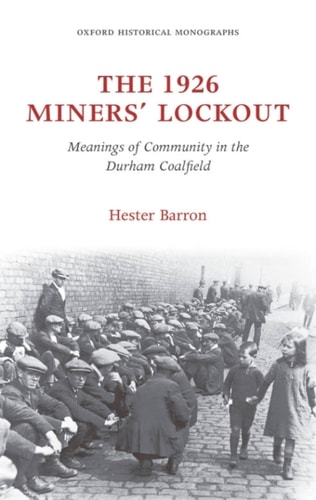
The 1926 Miners' Lockout: Meanings of Community in the Durham Coalfield
0
0
As an Amazon Associate and affiliate partner, Menrva Books earns from qualifying purchases. Learn more
Author Description
The miners' lockout of 1926 was a pivotal moment in British twentieth-century history. Opening with the heady days of the general strike, it continued for seven months and affected one million miners. In County Durham, where almost three in every ten adult men worked in the coal industry, its impact was profound. Hester Barron explores the way that the lockout was experienced by Durham's miners and their families. She investigates collective values and behaviour, focusing particularly on the tensions between identities based around class and occupation, and the rival identities that could cut across the creation of a cohesive community. Highlighting the continuing importance of differences due to gender, age, religion, poverty, and individual hopes and aspirations, she nevertheless finds that in 1926, despite such differences, the Durham coalfield continued to display the solidarity for which miners were famed. In response, Barron argues that the very concept of the 'mining community' needs to be reassessed. Rather than consisting of an homogeneous occupational identity, she suggests that the essence of community lay in its ability to subsume and integrate other categories of identity. A collective consciousness was further grounded in a shared historical narrative that had to be continually reinforced. It was the strength of such local solidarities that enabled both an exemplary regional response to the strike, and the ability to conceptualise such action within the wider framework of the national union. The 1926 Miners' Lockout provides crucial insights into issues of collective identity and collective action, illuminating wider debates about solidarity and fragmentation within working-class communities and cultures.
Menrva's Summary
THE THESIS
This work investigates how the 1926 miners' lockout in County Durham functioned as a crucible for collective identity and community cohesion within the British coal industry. Hester Barron, a historian specializing in twentieth-century British social history, utilizes archival records, local newspapers, and personal accounts to challenge traditional interpretations of the 'mining community.' She argues that rather than being a monolithic entity, the community was a complex integration of diverse identities—gendered, religious, and generational—that maintained solidarity through a shared historical narrative and localized action.
THE SCOPE MAP
What You Will Find
- Analysis of the 1926 general strike and the subsequent seven-month lockout in County Durham.
- Examination of social dynamics including gender roles, religious influence, and economic poverty.
- Theoretical framework for assessing collective identity and working-class solidarity.
- Primary source research from regional archives and contemporary accounts.
Scope Limits
- The study is geographically restricted to the Durham coalfield.
- It does not provide a comprehensive national history of the entire British mining industry during this period.
THE AUTHORITY PERSPECTIVE
Scholars and historians recognize this monograph as a significant contribution to the study of British labor history and the sociology of community identity. Readers frequently note the academic rigor of the prose and the author's success in balancing micro-historical detail with broader sociological arguments.
Page Count:
320
Publication Date:
2009-12-21
Publisher:
Oxford University Press
ISBN-10:
0191572411
ISBN-13:
9780191572418
History
European History
Social History
Sociology
British History
Coal Mining
Great Britain
Labor history
Community Tags
Similar Books