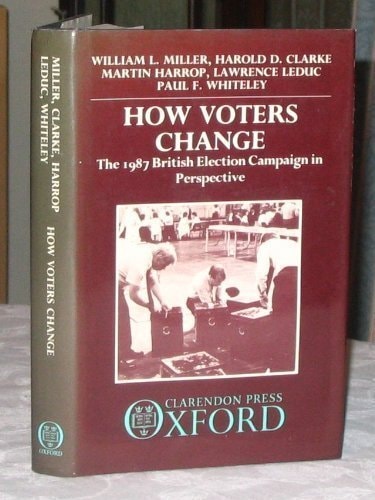
How Voters Change: The 1987 British Election Campaign in Perspective
0
0
As an Amazon Associate and affiliate partner, Menrva Books earns from qualifying purchases. Learn more
Author Description
This study highlights the power of governments to manipulate economic expectation and dominate mass media, thereby effecting voter change. Based upon a sequence of five interviews with approximately 1500 voters, this study reveals the nature, extent, and causes of rapid changes of political allegiance. The study begins with an analysis of Margaret Thatcher's third election campaign to restore her government's popularity, and then with the short, official, campaign in May and June 1987, charting day-to-day changes in public opinion and linking them to the changing content of television news. Finally, the authors examine voters' reactions to the electoral process and the election result. Students of British politics, survey methods, and mass media research will find this study provides new insight into the electoral process.
Menrva's Summary
THE THESIS
This study investigates how political campaigns, economic management, and media influence shape voter behavior and shifts in political allegiance during a national election. The authors, a team of established political scientists, utilize a longitudinal survey design to analyze the 1987 British general election. By tracking a cohort of 1500 voters through five distinct interview stages, the research provides a framework for understanding the volatility of public opinion and the strategic efforts of incumbent governments to regain popularity.
THE SCOPE MAP
What You Will Find
- Longitudinal survey data collected from 1500 voters across five interview phases.
- Analysis of the 1987 British general election campaign and Margaret Thatcher's reelection strategy.
- Examination of the correlation between television news content and daily fluctuations in voter sentiment.
- Methodological insights into measuring rapid shifts in political allegiance and economic expectations.
THE AUTHORITY PERSPECTIVE
Experts in British politics and survey methodology recognize this work as a significant empirical study of the 1987 election cycle. Readers frequently note the academic density of the prose and the precision of the statistical analysis provided by the authors.
Page Count:
320
Publication Date:
1990-10-11
Publisher:
Oxford University Press
ISBN-10:
0198273428
ISBN-13:
9780198273424
Great Britain
Sociology
Public opinion
British Politics
Mass media
Elections
Community Tags
Similar Books