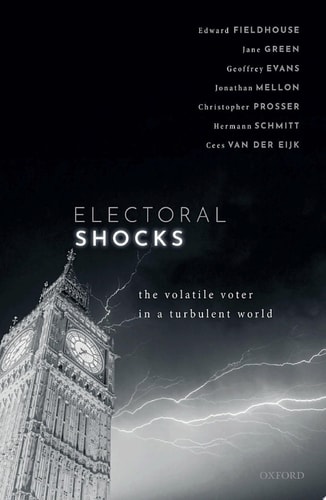
Electoral Shocks: The Volatile Voter in a Turbulent World
0
0
As an Amazon Associate and affiliate partner, Menrva Books earns from qualifying purchases. Learn more
Author Description
This is an open access title available under the terms of a CC BY-NC-ND 4.0 International licence. It is free to read at Oxford Scholarship Online and offered as a free PDF download from OUP and selected open access locations. Electoral Shocks: The Volatile Voter in a Turbulent World offers a novel perspective on British elections, focusing on the role of electoral shocks in the context of increasing electoral volatility. It demonstrates and explains the long-term trend in volatility, how shocks have contributed to the level of electoral volatility, and also which parties have benefited from the ensuing volatility. It follows in the tradition of British Election Study books, providing a comprehensive account of specific election outcomes- the General Elections of 2015 and 2017-and a more general and novel approach to understanding electoral change. The authors examine five electoral shocks that affected the elections of 2015 and 2017: the rise in immigration after 2004, particularly from Eastern Europe; the Global Financial Crisis prior to 2010; the coalition government of the Conservatives and the Liberal Democrats between 2010 and 2015; the Scottish Independence Referendum in 2014; and the European Union Referendum in 2016. The focus on electoral shocks offers an overarching explanation for the volatility in British elections, alongside the long-term trends that have led to this point. It offers a way to understand the rise and fall of the UK Independence Party (UKIP), Labour's disappointing 2015 performance and its later unexpected gains, the collapse in support for the Liberal Democrats, the dramatic gains of the Scottish National Party (SNP) in 2015, and the continuing period of tumultuous politics that has followed the EU referendum and the General Election of 2017. It provides a new way of understanding electoral choice in Britain, and also beyond, and a better understanding of the outcomes of recent elections.
Menrva's Summary
THE THESIS
How do external electoral shocks and long-term trends fundamentally reshape voter behavior and party outcomes in contemporary British elections? The authors, a team of prominent political scientists associated with the British Election Study, utilize extensive longitudinal data and comparative analysis to argue that electoral volatility is not merely a transient phenomenon but a structural shift driven by specific, high-impact events. By examining the interplay between established partisan loyalties and sudden political disruptions, the text provides a rigorous framework for understanding the decline of traditional party dominance and the rise of new political forces.
THE SCOPE MAP
What You Will Find
- Quantitative analysis of the 2015 and 2017 British General Elections
- A theoretical framework defining 'electoral shocks' as drivers of voter volatility
- Empirical assessment of five major shocks: 2004 immigration, the 2008 Global Financial Crisis, the 2010-2015 coalition government, the 2014 Scottish Independence Referendum, and the 2016 EU Referendum
Scope Limits
- The analysis is primarily confined to the British political landscape and may not be fully applicable to non-parliamentary systems
- The study focuses on specific election cycles and does not provide an exhaustive history of British politics beyond the scope of the identified shocks
THE AUTHORITY PERSPECTIVE
Experts recognize this work as a significant contribution to the British Election Study series, noting its utility for both academic researchers and students of political behavior. Readers frequently highlight the clarity of the data presentation and the effectiveness of the 'electoral shock' model in explaining recent political turbulence.
Page Count:
304
Publication Date:
2019-01-01
Publisher:
OUP Oxford
ISBN-10:
0192520857
ISBN-13:
9780192520852
Elections
British Politics
Comparative Government
Sociology
Public Policy
Community Tags
Similar Books






Reader Comments
Share Your Thoughts
No comments yet. Be the first to share your thoughts!