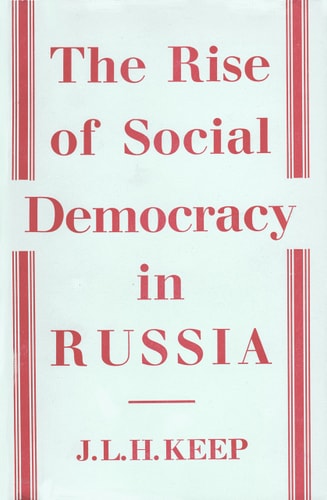
The Rise of Social Democracy in Russia
0
0
As an Amazon Associate and affiliate partner, Menrva Books earns from qualifying purchases. Learn more
Author Description
The Bolshevik revolution in Russia was the work of men who interpreted Marx in the light of their own experiences as members of the 'underground'. This book traces the doctrine we call 'Communism' or 'Leninism' to its roots in the early history of the Russian Social-Democratic Labor Party (RSDLP). It shows how this party gradually emerged as a force in the Russian politics, from the first Marxist discussion circle in the 1880's to the abortive revolution of 1905-7. Light is thrown on the Party's organization and relations with other opposition groups. It gives the background to the famous schism between Bolsheviks and Mensheviks in 1903, which revealed profound differences of out look among the Party leaders. Was the revolution to be an affair of the whole people, acting in accordance with the objective laws of historical development, or of a dedicated group of leaders prepared to reshape history according to their own design? was it to be democratic or authoritarian? in many respects these controversies of 60 years ago are supremely topical today. In Russia the view that the Communist Party cannot err prevents Soviet historians from examining its record impartially.. This account is based partly on Soviet sources - particularly works written before or after the Stalin period - and partly on documentary collections and archives available only in the West.
Menrva's Summary
THE THESIS
This work investigates the ideological and organizational origins of the Russian Social-Democratic Labor Party (RSDLP) to explain how early Marxist doctrine evolved into the authoritarian framework of Leninism. John L. H. Keep, a scholar of Russian history, synthesizes primary source material from Western archives and pre-Stalinist Soviet records to reconstruct the party's formative years. He argues that the internal schisms between Bolsheviks and Mensheviks were not merely tactical disagreements but fundamental conflicts regarding the nature of revolutionary leadership and democratic participation. By examining the transition from clandestine discussion circles to a structured political force, the text clarifies the roots of the Soviet state's governing philosophy.
THE SCOPE MAP
What You Will Find
- A detailed historical analysis of the Russian Social-Democratic Labor Party from the 1880s through the 1907 revolution.
- An examination of the ideological divide between Bolshevik and Menshevik factions regarding democratic versus authoritarian governance.
- A comparative study utilizing both Western archival documents and Soviet-era historical accounts.
- An investigation into the organizational mechanics of underground political movements in late Imperial Russia.
THE AUTHORITY PERSPECTIVE
Historians and political scientists recognize this text as a rigorous examination of the early RSDLP, particularly for its objective handling of sources that were often obscured by later Soviet historiography. Readers frequently note the academic density of the prose, which provides a foundational understanding of the ideological tensions that defined 20th-century Russian politics.
Page Count:
334
Publication Date:
1997-11-01
Publisher:
Oxford University Press
ISBN-10:
0198271476
ISBN-13:
9780198271475
History
Socialism
Russia
Political History
Communism
Community Tags
Similar Books