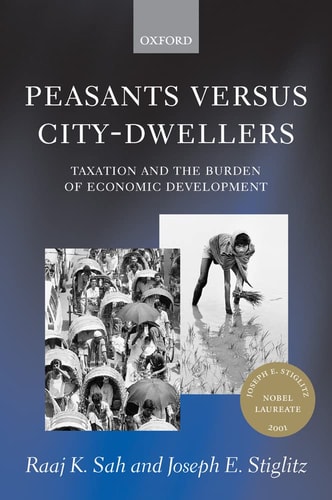
Peasants Versus City-Dwellers: Taxation and the Burden of Economic Development
0
0
As an Amazon Associate and affiliate partner, Menrva Books earns from qualifying purchases. Learn more
Author Description
From the historical perspective, the two central problems facing most of the developing countries are: Who should bear the burden of the costs of development? and How should these costs be shared between those in the urban and rural sectors? The inevitable conflicts between the two have, in fact, been a long standing theme, reflected in the debates, in Britain over the Corn Laws, in the United States over industrial tariffs, and in Russia over the size of the "scissors." The book provides for the first time a unifying framework within which these questions can be systematically approached.From the perspective of modern public finance, this book provides the first systematic treatment incorporating the distinctive features of developing countries. Raaj K. Sah and Joseph E. Stiglitz not only show that the consequences of various tax policies are distinctly different from what they would be in a more developed economy, but they also develop a simple framework for assessing both efficiency and equity consequences of a wide variety of policies. They show how their approach can be extended to include issues of cost benefit analysis and agricultural pricing.While the authors break new ground, the book is written to be accessible to a wider audience, including practicing development economists. Each chapter includes a nontechnical discussion of the central problems at hand and a summary of the conclusions of the analysis.
Menrva's Summary
THE THESIS
This book investigates the fundamental question of how the financial burden of economic development should be distributed between rural and urban populations in developing nations. Authors Joseph E. Stiglitz and Raaj K. Sah, both distinguished economists, utilize the principles of modern public finance to construct a systematic framework for evaluating tax policies. By contrasting the economic realities of developing countries with those of industrialized nations, they provide a methodology for assessing both the efficiency and equity of various fiscal interventions.
THE SCOPE MAP
What You Will Find
- A comparative analysis of historical economic conflicts, including the British Corn Laws and the Russian scissors crisis.
- A unified theoretical framework for evaluating tax policy, agricultural pricing, and cost benefit analysis.
- Systematic treatment of economic features unique to developing nations that differentiate them from developed economies.
- Nontechnical summaries at the end of each chapter designed to bridge the gap between academic theory and practical application.
THE AUTHORITY PERSPECTIVE
Experts recognize this work as a foundational text for understanding the intersection of fiscal policy and sectoral development. Readers frequently note that while the book addresses complex economic theory, the inclusion of nontechnical summaries makes the core arguments accessible to practitioners and policymakers alike.
Page Count:
240
Publication Date:
1993-02-11
Publisher:
Oxford University Press
ISBN-10:
0198285817
ISBN-13:
9780198285816
Economics
Rural poor
Taxation
Developing Countries
Public Finance
Community Tags
Similar Books