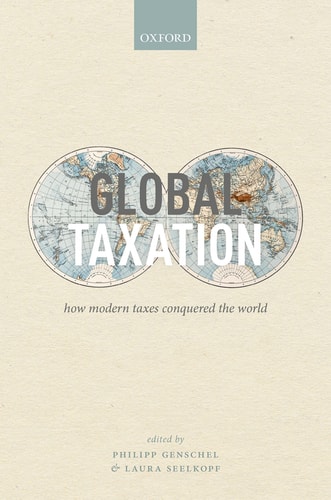
Global Taxation: How Modern Taxes Conquered the World
0
0
As an Amazon Associate and affiliate partner, Menrva Books earns from qualifying purchases. Learn more
Author Description
Global Taxation investigates the global transition to modern taxation from the 18th century to today. Modern taxation refers to the broad-based tax instruments that allowed for the emergence of big government as we know it today, including, most prominently, income taxes and general consumption taxes. The volume draws on a new historical dataset of tax introduction worldwide to map the global spread of modern taxes descriptively and to explore its correlates analytically. It makes four contributions to the literature. First, it corrects a pervasive Western bias in historical political economy and fiscal sociology. Most of this literature focuses heavily on the tax policy of advanced democracies in Europe. The chapters of this volume explore how far Western theories and insights travel to non-Western contexts. Second, the volume mitigates a recency bias in much of the macro-quantitative literature in comparative political economy and public finance. The chapters investigate whether insights travel across time from recent to more distant periods of observation. Third, the volume compensates for the substantive preoccupation of extant research with the personal income tax and the VAT by extending the analysis to other important tax instruments: the corporate income tax, the inheritance tax, non-VAT sales taxes, and social security contributions. Finally, the volume goes beyond the prevalent methodological nationalism in fiscal sociology and comparative political economy. It shows that non-sovereign tax introductions were common in colonial and imperial settings and compares analytically how the logic of these non-sovereign introductions differed from sovereign ones.
Menrva's Summary
THE THESIS
This volume investigates the historical transition to modern taxation and the subsequent emergence of big government on a global scale. Authors Laura Seelkopf and Philipp Genschel utilize a comprehensive historical dataset to analyze the spread of tax instruments such as income and consumption taxes. By examining these developments across diverse geographical and temporal contexts, the authors challenge existing Western-centric theories in fiscal sociology and political economy.
THE SCOPE MAP
What You Will Find
- A global historical dataset covering tax introductions from the 18th century to the present.
- Comparative analysis of sovereign versus non-sovereign tax implementation in colonial and imperial settings.
- Examination of diverse tax instruments including corporate income tax, inheritance tax, and social security contributions.
Scope Limits
- The analysis focuses primarily on the macro-quantitative spread of tax instruments rather than individual taxpayer experiences.
- The study does not provide detailed legislative histories for every nation-state included in the dataset.
THE AUTHORITY PERSPECTIVE
Experts recognize this volume as a significant corrective to the Western-centric bias prevalent in historical political economy and fiscal sociology. Readers frequently note the academic density of the prose and the utility of the new historical dataset for comparative research.
Page Count:
304
Publication Date:
2022-05-17
Publisher:
Oxford University Press
ISBN-10:
0192897578
ISBN-13:
9780192897572
History
Economics
Public Finance
Taxation
Taxation history
Sociology
Finance Public
Community Tags
Similar Books