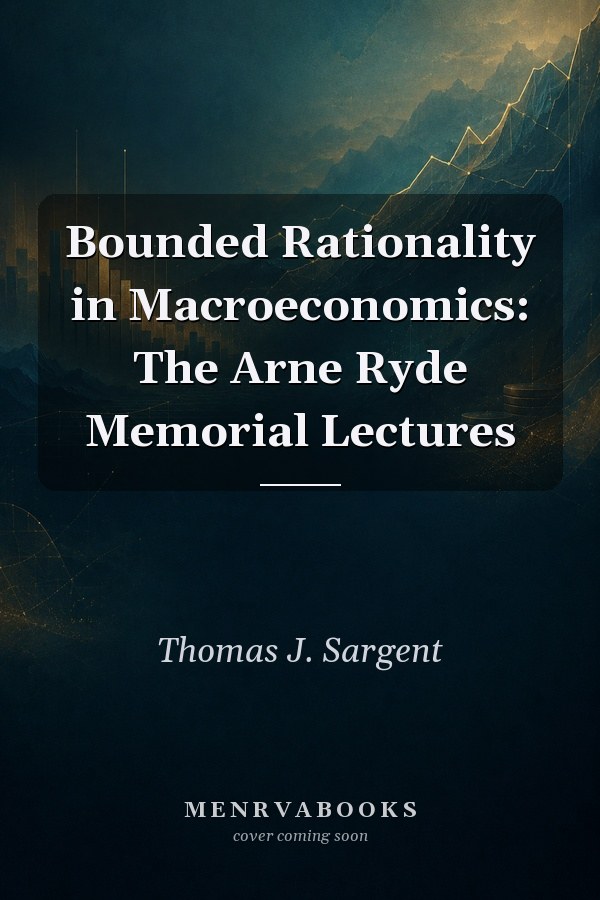
Bounded Rationality in Macroeconomics: The Arne Ryde Memorial Lectures
0
0
As an Amazon Associate and affiliate partner, Menrva Books earns from qualifying purchases. Learn more
Author Description
How do people behave in new situations in which previous experience is not useful? The recent changes in Eastern Europe, for example, are unprecedented and there is not an available model on which to base the mechanisms that will govern the economics in this region. The concept of "bounded (or limited) rationality" is being developed to analyze behavior in such situations. In this book Thomas Sargent describes and interprets the recent work in the area, especially in statistics, econometrics, networks and artificial intelligence. He focuses on examples designed to illustrate the issues involved and the kinds of questions that are being asked and answered in this research. He points to further potential positive developments of the theory as well as some of its limitations.
Menrva's Summary
THE THESIS
This book investigates how economic agents make decisions in novel environments where historical data and past experience provide no reliable guidance. Thomas J. Sargent, a prominent economist, utilizes the framework of bounded rationality to address the limitations of traditional rational expectations models. By synthesizing developments from statistics, econometrics, and artificial intelligence, the author constructs a methodology for modeling behavior in unprecedented economic scenarios, such as the transition of Eastern European economies.
THE SCOPE MAP
What You Will Find
- Analysis of decision-making processes in environments lacking historical precedent
- Integration of artificial intelligence and network theory into macroeconomic modeling
- Evaluation of statistical and econometric techniques for limited rationality
- Discussion of the theoretical limitations and future trajectories of bounded rationality research
THE AUTHORITY PERSPECTIVE
Experts recognize this work as a significant contribution to the evolution of macroeconomic theory, particularly for its bridge between classical economics and computational intelligence. Readers frequently note the technical density of the prose, which assumes a strong background in econometrics and formal economic modeling.
Page Count:
200
Publication Date:
1994-02-03
Publisher:
Clarendon Press
ISBN-10:
0198288697
ISBN-13:
9780198288695
Economics
Statistics
Macroeconomics
Econometrics