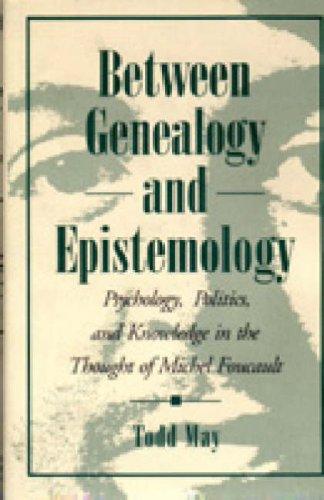
Between Genealogy and Epistemology
0
0
As an Amazon Associate and affiliate partner, Menrva Books earns from qualifying purchases. Learn more
Author Description
Michel Foucault introduced a new form of political thinking and discourse. Rather than seeking to understand the grand unities of state, economy, or exploitation, he tried to discover the micropolitical workings of everyday life that have often founded the greater unities. He was particularly concerned with how we understand ourselves psychologically, and thus with how psychological knowledge developed and came to be accepted as true. In the course of his writings, he developed a genealogy of psychology, an account of psychology as a historically developed practice of power. The problem such an account raises for much of traditional philosophy is that Foucault's critique of psychological concepts is ultimately a critique of the idea of the mind as a politically neutral ontological concept. As such, it renders politically suspect all forms of subjective foundationalism, and the epistemological justification for Foucault's own writings is then called into question. Drawing on the writings of such Anglo-American philosophers as Wilfrid Sellars and Ludwig Wittgenstein, Todd May refutes the idea that Foucault's critiques of knowledge, and especially psychological knowledge, undermine themselves.
Menrva's Summary
THE THESIS
This book investigates the epistemological implications of Michel Foucault's genealogical critique of psychology and its impact on subjective foundationalism. Todd May addresses the challenge Foucault's work poses to traditional philosophy by questioning the political neutrality of psychological concepts and the self-justification of Foucault's own critiques. The book draws upon Anglo-American philosophers Wilfrid Sellars and Ludwig Wittgenstein to argue that Foucault's critiques do not undermine themselves. It explores how Foucault's micropolitical analysis of everyday life and the development of psychological knowledge can be reconciled with robust epistemological frameworks.
THE SCOPE MAP
- What You Will Find:
- An analysis of Michel Foucault's genealogical method as applied to psychology.
- An examination of Foucault's critique of subjective foundationalism and its political implications.
- A refutation of the idea that Foucault's critiques of knowledge are self-undermining.
- The application of insights from Wilfrid Sellars and Ludwig Wittgenstein to Foucault's work.
- An exploration of the relationship between epistemology and political thinking in Foucault's discourse.
- Discussion of how psychological knowledge has developed as a practice of power.
THE AUTHORITY PERSPECTIVE
The Authority Perspective: This work is recognized for its rigorous engagement with Foucault's complex thought, particularly his genealogical method and its implications for epistemology. By drawing on Anglo-American philosophical traditions, Todd May offers a nuanced defense against charges that Foucault's critiques are self-defeating. The book is considered a significant contribution to Foucault scholarship and the philosophy of science, providing a framework for understanding the political dimensions of knowledge production.
Page Count:
136
Publication Date:
1993-01-01
ISBN-10:
0271009055
ISBN-13:
9780271009056
Non-Fiction
Philosophy
Political Theory
Epistemology
History of Psychology
Community Tags
Similar Books