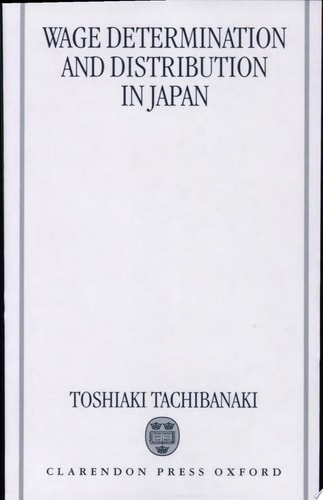
Wage Determination and Distribution in Japan
0
0
As an Amazon Associate and affiliate partner, Menrva Books earns from qualifying purchases. Learn more
Author Description
In the wake of its wartime destruction, Japan experienced a period of strong industrialization in the 1950s and 1960s, reaching an exceptionally high level of per-capita GNP or per-capita income. After the two oil crises, the growth rate of the economy declined, and it has since stabilized. During this stable period, Japan's macroeconomic performance, in particular the level of unemployment, has been considerably better than that of other industrialized countries. This economic performance can provide us with valuable information on the role of wages and of the labor market.In this book, Professor Tachibanaki investigates the empirical and theoretical issues of wage determination and wage differentials in Japan since the War, concentrating on recent developments. He also examines the relationship between the role of wages and such features of the labor market as employment and unemployment. Japan's institutional singularities - including what the OECD called the `Three Sacred Treasures of the Imperial Houses': nenko-joretsu (seniority system), life-long employment, and enterprise unionism - are investigated on both efficiency and equity grounds.The Japanese authorities collect a great variety of macroeconomic data, including data relating to the labor market which is categorized according to a large number of demographic variables and firm characteristics. Professor Tachibanaki reports and analyses the data that is publicly available, including the Ministry of Labor's annual Wage Structure Survey of over one million employees, enriching it with its own research observations. An introduction to the main characteristics of the labor market, industrial relations system, and wage in Japan, explaining the degree of difference from Europe and the USA, establishes a framework for labor economists relatively new to the study of Japan. Detailed explanations of wage determination according to sex, age, education, experience, occupation, size of firm, and performance takes the
Menrva's Summary
THE THESIS
This book investigates the empirical and theoretical mechanisms governing wage determination and distribution within the Japanese labor market during the post-war era. Professor Toshiaki Tachibanaki, an expert in labor economics, utilizes extensive macroeconomic datasets and institutional analysis to evaluate how Japan's unique labor practices influence economic efficiency and equity. By contrasting Japanese systems with those of Western nations, the author provides a framework for understanding how specific employment structures contribute to macroeconomic stability and low unemployment rates.
THE SCOPE MAP
What You Will Find
- Analysis of the 'Three Sacred Treasures' of Japanese labor: seniority-based pay, life-long employment, and enterprise unionism.
- Empirical examination of wage differentials based on demographic variables including sex, age, education, and occupation.
- Utilization of the Ministry of Labor's annual Wage Structure Survey covering over one million employees.
- Comparative study of Japanese industrial relations versus those found in the United States and Europe.
THE AUTHORITY PERSPECTIVE
Experts recognize this work as a foundational text for understanding the structural nuances of the Japanese labor market during the late 20th century. Scholars frequently cite the book for its rigorous use of large-scale government data and its clear explanation of institutional singularities in Japanese economic policy.
Page Count:
288
Publication Date:
1996-07-25
Publisher:
Oxford University Press
ISBN-10:
0198288654
ISBN-13:
9780198288657
Economics
Sociology
Japan
Industrial Relations
Wages_japan
Community Tags
Similar Books