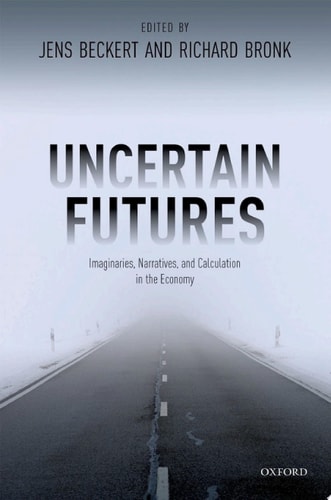
Uncertain Futures: Imaginaries, Narratives, and Calculation in the Economy
0
0
As an Amazon Associate and affiliate partner, Menrva Books earns from qualifying purchases. Learn more
Author Description
Uncertain Futures considers how economic actors visualize the future and decide how to act in conditions of radical uncertainty. It starts from the premise that dynamic capitalist economies are characterized by relentless innovation and novelty and hence exhibit an indeterminacy that cannot be reduced to measurable risk. The organizing question then becomes how economic actors form expectations and make decisions despite the uncertainty they face. This edited volume lays the foundations for a new model of economic reasoning by showing how, in conditions of uncertainty, economic actors combine calculation with imaginaries and narratives to form fictional expectations that coordinate action and provide the confidence to act. It draws on groundbreaking research in economic sociology, economics, anthropology, and psychology to present theoretically grounded empirical case studies. These demonstrate how grand narratives, central bank forward guidance, economic forecasts, finance models, business plans, visions of technological futures, and new era stories influence behaviour and become instruments of power in markets and societies. The market impact of shared calculative devices, social narratives, and contingent imaginaries underlines the rationale for a new form of narrative economics.
Menrva's Summary
THE THESIS
How do economic actors form expectations and make decisions when faced with radical uncertainty that cannot be reduced to measurable risk? Editors Jens Beckert and Richard Bronk, both established scholars in economic sociology and political economy, curate a collection of essays that challenge traditional rational-choice models. The volume argues that in dynamic capitalist systems, actors rely on a combination of quantitative calculation, imaginative projections, and social narratives to construct 'fictional expectations' that facilitate action and market coordination.
THE SCOPE MAP
What You Will Find
- Theoretical frameworks integrating economic sociology, anthropology, and psychology.
- Analysis of central bank forward guidance and economic forecasting models.
- Case studies on business planning, technological innovation, and market-shaping narratives.
- Exploration of how shared imaginaries function as instruments of power.
Scope Limits
- Does not provide a predictive model for specific market outcomes.
- Does not focus on micro-level individual psychological cognitive biases, but rather on the social and institutional construction of the future.
THE AUTHORITY PERSPECTIVE
Experts identify this volume as a significant contribution to the field of narrative economics and the sociology of finance. Readers frequently note the academic density of the prose, which is best suited for researchers and students interested in the intersection of economic theory and social science.
Page Count:
352
Publication Date:
2018-01-01
Publisher:
OUP Oxford
ISBN-10:
0192552759
ISBN-13:
9780192552754
Economics
Principles of Management
Uncertainty
Earth Sciences
Electricity & Magnetism
Economics
Decision Making
Finance
Social Theory
Community Tags
Similar Books