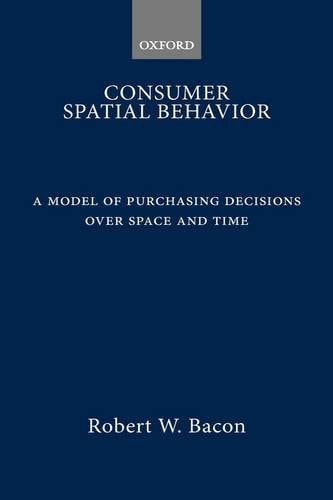
Consumer Spatial Behavior: A Model of Purchasing Decisions over Space and Time
0
0
As an Amazon Associate and affiliate partner, Menrva Books earns from qualifying purchases. Learn more
Author Description
A theoretical book on the locational aspects of consumer behaviour which makes an original contribution to economic geography as well as to the purchasing behaviour model used by economists. Subjects considered the allocation of shopping trips with fixed frequencies; the determination of market areas when frequency is fixed; shopping patterns and choice of transport mode and retrospect and prospect. graduate courses in economic geography; economics courses in consumer behaviour; courses in town planning and urban architecture.
Menrva's Summary
THE THESIS
This book investigates the theoretical framework governing how consumers make purchasing decisions when constrained by spatial location and temporal frequency. Robert W. Bacon utilizes economic modeling to analyze the intersection of geography and consumer choice, providing a structured approach to understanding how individuals allocate shopping trips. By integrating economic theory with spatial analysis, the text offers a rigorous examination of market area determination and the logistical factors influencing consumer movement. The work serves as a formal inquiry into the mechanics of retail interaction within urban environments.
THE SCOPE MAP
What You Will Find
- Theoretical models for the allocation of shopping trips with fixed frequencies
- Analysis of market area determination under spatial constraints
- Examination of shopping patterns and the choice of transport modes
- Retrospective and prospective evaluations of consumer behavior models
THE AUTHORITY PERSPECTIVE
Experts identify this work as a specialized contribution to the fields of economic geography and urban planning. Readers frequently note the technical density of the prose, which is intended for graduate-level study in economics and architecture.
Page Count:
182
Publication Date:
1984-12-13
Publisher:
Oxford University Press
ISBN-10:
0198284764
ISBN-13:
9780198284765
Economics
Consumer Behavior
Consumers
Economic Geography
urban planning
Community Tags
Similar Books