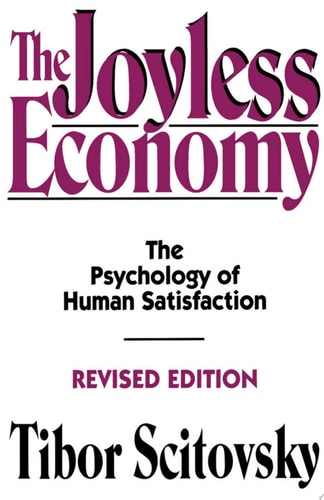
The Joyless Economy: The Psychology of Human Satisfaction and Consumer Dissatisfaction
0
0
As an Amazon Associate and affiliate partner, Menrva Books earns from qualifying purchases. Learn more
Author Description
When this classic work was first published in 1976, its central tenet--more is not necessarily better--placed it in direct conflict with mainstream thought in economics. Within a few years, however, this apparently paradoxical claim was gaining wide acceptance. Scitovsky's ground-breaking book was the first to apply theories of behaviorist psychology to questions of consumer behavior and to do so in accessible, non-technical language. Setting out to analyze the failures of our consumerist lifestyle, Scitovsky concluded that people's need for stimulation is so vital that it can lead to violence if not satisfied by novelty--whether in challenging work, art, fashion, gadgets, late-model cars, or scandal.Though much of the book stands as a record of American post-war prosperity and its problems, the revised edition also takes into account recent social and economic changes. A new preface and a foreword by economist Robert Frank cover some of these issues. Two revised chapters discuss the assimilation of counter-cultural ideas throughout American society, especially ideas concerning the quality of life. Scitovsky draws fascinating connections between the new elite of college-educated consumers and the emergence of a growing underclass plagued by drugs and violence, perceptively tracing the reactions of these disparate groups to the problems of leisure and boredom. In the wake of the the so-called "decade of greed" and amidst calls for a "kinder, gentler" society, The Joyless Economy seems more timely than ever.
Menrva's Summary
THE THESIS
This work investigates the core question of why increased material prosperity and consumption do not necessarily lead to higher levels of human satisfaction. Tibor Scitovsky, a distinguished economist, utilizes theories from behaviorist psychology to challenge the traditional economic assumption that more consumption equates to greater well-being. He argues that the human need for stimulation and novelty is a fundamental driver of behavior, and that the failure to satisfy this need through meaningful engagement leads to societal dysfunction and dissatisfaction.
THE SCOPE MAP
What You Will Find
- Analysis of the psychological underpinnings of consumer behavior and the human need for stimulation.
- Examination of the relationship between leisure, boredom, and social violence.
- Comparison of consumption patterns across different socioeconomic classes.
- Discussion on the assimilation of counter-cultural ideas regarding quality of life into mainstream society.
THE AUTHORITY PERSPECTIVE
Experts recognize this text as a foundational critique of traditional economic models that ignore psychological variables. Readers frequently note the accessibility of the prose despite the complex synthesis of economic theory and behavioral psychology.
Page Count:
328
Publication Date:
1977-04-14
Publisher:
Oxford University Press
ISBN-10:
0195021835
ISBN-13:
9780195021837
Psychology
Economics
Satisfaction
Sociology
Consumers
Social Science
Consumer Behavior
Community Tags
Similar Books