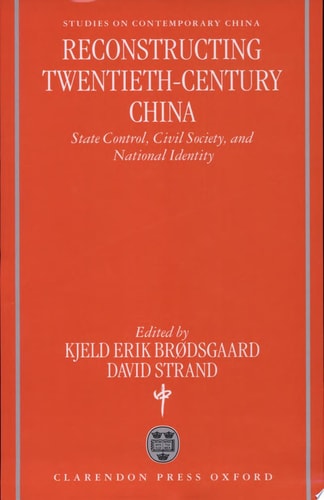
Reconstructing Twentieth-Century China: State Control, Civil Society, and National Identity
0
0
As an Amazon Associate and affiliate partner, Menrva Books earns from qualifying purchases. Learn more
Author Description
This book examines the important theme of reform and reconstruction in twentieth century China, focusing particularly on the Deng era. Chapters are organized around three crucial issues: (i) the extent and limits of state control over economic, social, and cultural life; (ii) prospects for the development of a civil society separate from state control;and (iii) the struggle to define a Chinese national identity which takes China's ethnic diversity into consideration.
Menrva's Summary
THE THESIS
This volume investigates the complex interplay between state authority, emerging civil society, and the formation of national identity during the transformative twentieth century in China. Authors David Strand and Kjeld Erik Brødsgaard synthesize academic research to analyze how the Chinese state has navigated the tensions between centralized control and the pressures of modernization. By focusing on the Deng era, the text provides a framework for understanding the structural shifts in economic, social, and cultural governance that continue to shape the nation's trajectory.
THE SCOPE MAP
What You Will Find
- Analysis of the extent and limitations of state control over economic and cultural sectors.
- Evaluation of the development of civil society institutions independent of government oversight.
- Examination of the challenges in defining a cohesive national identity amidst significant ethnic diversity.
- Historical assessment of reform policies implemented during the Deng Xiaoping era.
THE AUTHORITY PERSPECTIVE
Scholars and students of contemporary Chinese history frequently cite this work as a foundational text for understanding the structural evolution of the Chinese state. Experts highlight the book's balanced approach to complex socio-political issues, noting its utility for those seeking a rigorous academic overview of twentieth-century reform.
Page Count:
360
Publication Date:
1998-11-12
Publisher:
Clarendon Press
ISBN-10:
0198293119
ISBN-13:
9780198293118
History
Asian Studies
China
Sociology
Community Tags
Similar Books