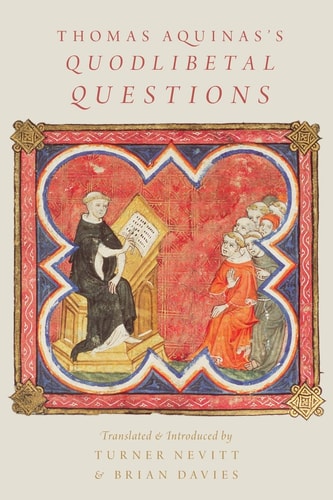
Thomas Aquinas's Quodlibetal Questions
0
0
As an Amazon Associate and affiliate partner, Menrva Books earns from qualifying purchases. Learn more
Author Description
Thomas Aquinas was one of the most significant Christian thinkers of the middle ages and ranks among the greatest philosophers and theologians of all time. In the mid-thirteenth century, as a teacher at the University of Paris, Aquinas presided over public university-wide debates on questions that could be put forward by anyone about anything. The Quodlibetal Questions are Aquinas's edited records of these debates. Unlike his other disputed questions, which are limited to a few specific topics such as evil or divine power, Aquinas's Quodlibetal Questions contain his treatment of hundreds of questions on a wide range of topics--from ethics, metaphysics, philosophy of mind, and philosophy of religion to dogmatic theology, sacramental theology, moral theology, eschatology, and much more. And, unlike his other disputed questions, none of the questions treated in his Quodlibetal Questions were of Aquinas's own choosing--they were all posed for him to answer by those who attended the public debates. As such, this volume provides a window onto the concerns of students, teachers, and other interested parties in and around the university at that time. For the same reason it contains some of Aquinas's fullest, and in certain cases his only, treatments of philosophical and theological questions that have maintained their interest throughout the centuries.
Menrva's Summary
THE THESIS
This volume investigates the intellectual landscape of the thirteenth-century University of Paris through the lens of Thomas Aquinas's public debates. Brian L. Davies and Turner Nevitt provide a scholarly framework for understanding these edited records, which capture the spontaneous and diverse inquiries posed to Aquinas by his contemporaries. The text argues that these questions serve as a unique historical and philosophical record, revealing the specific concerns of medieval students and scholars while showcasing Aquinas's methodology in addressing topics outside his own predetermined research agenda.
THE SCOPE MAP
What You Will Find
- Edited transcripts of public university-wide debates from the mid-thirteenth century.
- Comprehensive coverage of topics including ethics, metaphysics, philosophy of mind, and sacramental theology.
- Historical context regarding the academic environment of the University of Paris.
Scope Limits
- The text does not provide a general biography of Aquinas or a systematic introduction to his broader corpus.
- It does not offer modern interpretations or contemporary applications of the theological arguments presented.
THE AUTHORITY PERSPECTIVE
Scholars and students of medieval philosophy frequently identify this work as a critical primary source for understanding the breadth of Aquinas's intellectual engagement. Experts highlight the text's value in demonstrating how Aquinas navigated spontaneous, audience-driven inquiries compared to his more structured theological treatises.
Page Count:
592
Publication Date:
2019-11-12
Publisher:
Oxford University Press
ISBN-10:
0190069538
ISBN-13:
9780190069537
Philosophy
Academic
Christian Thought
Theology
New Used & Rental Textbooks
Community Tags
Similar Books