British Government in Crisis
0
0
As an Amazon Associate and affiliate partner, Menrva Books earns from qualifying purchases. Learn more
Author Description
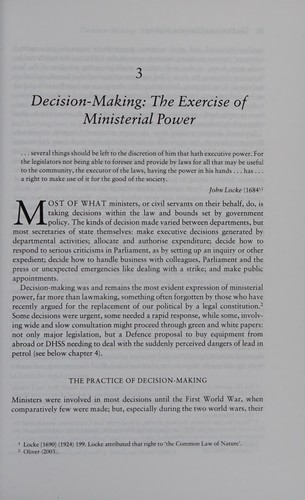
Why are we badly governed? Why has a system of government - the envy of the world as recently as the 1970s - developed so many defects? Why is there such a gulf between political classes, who seem to believe the position satisfactory or inevitable, and the general public, increasingly disaffected by politics and government? This book argues that the defects are not attributable to one political party. Some factors are outside politicians' control: the globalization of economic activity; the changes in international politics after the end of Soviet Russia; the adverse consequences of more dominating and competitive media. Some other factors are widely recognized: the decline of the cabinet and the marginalizing of Parliament; the influence of spin on our political culture; the increased role of political and special advisers. But others are not as well understood. Among them are the decline in the authority of many ministers, the undermining of the constitutional position and consequent effectiveness of the civil service, the fragmentation of government and the public sector into a mass of bodies with complex but ill-defined relations between them, and the ramifying of a system of government which, despite its protestations, is less interested in delivering results than managing news. The book traces these developments, especially over the last 25 years, but most intensively since 1997. It looks to a major change in the ways of government. It doubts whether a change of prime minister or party would remove current defects. It considers other possible alternatives, particularly a constitutional change to a 'presidential' system of government, or the introduction of a legal constitution. It concludes by arguing that, although venturing in new and untried directions might seem attractive, improvement - radical improvement - of the system we have is more likely to achieve better government and restore public confidence
Menrva's Summary
THE THESIS
This book investigates the systemic failures and declining effectiveness of British governance, questioning why a once-admired system has become a source of public disaffection. It argues that the current defects are not partisan but stem from a complex interplay of external factors like globalization and media influence, alongside internal issues such as the erosion of ministerial authority, the weakening of the civil service, and the fragmentation of government structures. The analysis focuses on developments over the last 25 years, with particular emphasis since 1997, and explores potential reforms, including a presidential system or a legal constitution, while ultimately advocating for radical improvements to the existing framework to restore public confidence and deliver better results.
THE SCOPE MAP
- Analysis of the decline in the authority of ministers and the constitutional position of the civil service.
- Examination of the fragmentation of government and the public sector into numerous bodies.
- Discussion of the increased role of political and special advisers and the influence of 'spin'.
- Exploration of external factors such as globalization and changes in international politics.
- Critique of the marginalizing of Parliament and the decline of the cabinet system.
- Investigation into the shift from delivering results to managing news within government.
- Consideration of alternative governmental systems, including a 'presidential' model and a legal constitution.
- Focus on the period from the 1970s to the present, with intensive analysis since 1997.
THE AUTHORITY PERSPECTIVE
The book offers a critical examination of the British governmental system, positing that its current failings are multifaceted and not attributable to a single political party. It identifies both external pressures and internal structural weaknesses as key contributors to the perceived crisis in governance. The analysis suggests that significant reform, potentially including a move towards a presidential system or the adoption of a legal constitution, may be necessary to address these deep-seated issues and rebuild public trust. The author's perspective is that incremental changes to the current system are unlikely to suffice, advocating instead for a more radical overhaul to improve governmental effectiveness and public confidence.
Page Count:
336
Publication Date:
2005-01-01
ISBN-10:
1841135496
Science
History
Politics
Non-Fiction
Government
Community Tags
Similar Books