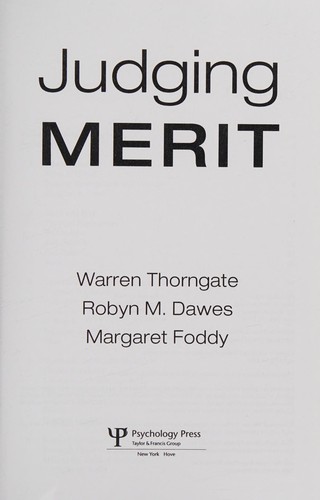
Judging Merit
0
0
As an Amazon Associate and affiliate partner, Menrva Books earns from qualifying purchases. Learn more
Author Description
Merit-based tests and contests have become popular methods for allocating rewards - from trophies to contracts, jobs to grants, admissions to licenses. With origins in jurisprudence, methods of rewarding merit seem fairer than those rewarding political or social connections, bribery, aggression, status, or wealth. Because of this, merit-based competitions are well-suited to the societal belief that people should be rewarded for what they know or do, and not for who they know or are; however, judging merit is rarely an easy task - it is prone to a variety of biases and errors. Small biases and errors, especially in large competitions, can make large differences in who or what is rewarded. It is important, then, to learn how to spot flaws in procedures for judging merit and to correct them when possible. Based on over 20 years of theory and research in human judgment, decision making and social psychology, this unique book brings together for the first time what is known about the processes and problems of judging merit and their consequences. It also provides practical suggestions for increasing the fairness of merit-based competitions, and examines the future and limits of these competitions in society.--Jacket.
Menrva's Summary
THE THESIS
This book investigates the inherent difficulties and biases present in merit-based systems for allocating rewards. Drawing on over two decades of research in human judgment, decision-making, and social psychology, Warren Thorngate's work synthesizes existing knowledge on the processes, problems, and consequences of judging merit. The book aims to equip readers with the ability to identify flaws in merit-based procedures and offers practical strategies for enhancing fairness in competitions, while also exploring the future and limitations of such systems in society.
THE SCOPE MAP
- What You Will Find:
- Analysis of the origins of merit-based jurisprudence and its perceived fairness compared to other allocation methods.
- Examination of the psychological and social factors contributing to biases and errors in merit judgment.
- Discussion of how small biases can have significant impacts, particularly in large-scale competitions.
- Practical suggestions and theoretical frameworks for increasing the fairness of merit-based competitions.
- Exploration of the future trajectory and inherent limitations of merit-based systems in contemporary society.
THE AUTHORITY PERSPECTIVE
The Authority Perspective: This book is positioned as a comprehensive synthesis of research on judging merit, drawing from extensive theory and empirical study in human judgment, decision-making, and social psychology. It is intended for those interested in understanding and improving the fairness of competitive systems, offering both analytical insights and practical recommendations. The work appears to be a valuable resource for academics, policymakers, and anyone involved in designing or participating in merit-based evaluations.
Page Count:
200
Publication Date:
2009-01-01
ISBN-10:
0805858350
ISBN-13:
9780805858358
Non-Fiction
Psychology
Fairness
Decision Making
Community Tags
Similar Books