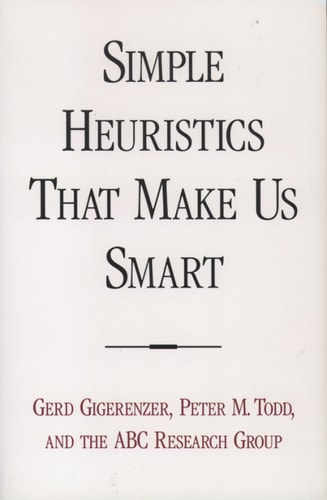
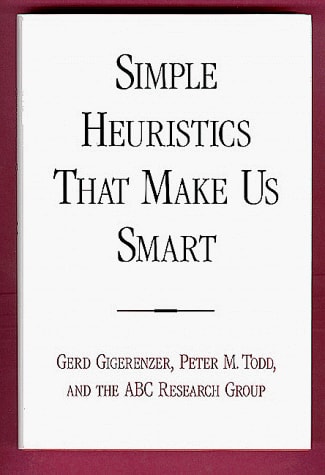
Simple Heuristics that Make Us Smart
0
0
As an Amazon Associate and affiliate partner, Menrva Books earns from qualifying purchases. Learn more
Author Description
Simple Heuristics That Make Us Smart invites readers to embark on a new journey into a land of rationality that differs from the familiar territory of cognitive science and economics. Traditional views of rationality tend to see decision makers as possessing superhuman powers of reason, limitless knowledge, and all of eternity in which to ponder choices. To understand decisions in the real world, we need a different, more psychologically plausible notion of rationality, and this book provides it. It is about fast and frugal heuristics--simple rules for making decisions when time is pressing and deep thought an unaffordable luxury. These heuristics can enable both living organisms and artificial systems to make smart choices, classifications, and predictions by employing bounded rationality. But when and how can such fast and frugal heuristics work? Can judgments based simply on one good reason be as accurate as those based on many reasons? Could less knowledge even lead to systematically better predictions than more knowledge? Simple Heuristics explores these questions, developing computational models of heuristics and testing them through experiments and analyses. It shows how fast and frugal heuristics can produce adaptive decisions in situations as varied as choosing a mate, dividing resources among offspring, predicting high school drop out rates, and playing the stock market. As an interdisciplinary work that is both useful and engaging, this book will appeal to a wide audience. It is ideal for researchers in cognitive psychology, evolutionary psychology, and cognitive science, as well as in economics and artificial intelligence. It will also inspire anyone interested in simply making good decisions.
Menrva's Summary
THE THESIS
This book investigates how simple decision-making rules, or heuristics, can produce accurate and adaptive outcomes in complex, real-world environments. The authors, a collaborative team led by Gerd Gigerenzer and Peter M. Todd, challenge the traditional economic model of unbounded rationality. By utilizing computational modeling and empirical testing, they argue that limited information and time constraints do not necessarily hinder decision quality but can instead facilitate more effective choices through bounded rationality.
THE SCOPE MAP
What You Will Find
- Computational models of fast and frugal heuristics
- Analysis of decision-making in biological and artificial systems
- Experimental data on prediction accuracy versus information volume
- Case studies ranging from mate selection to financial market behavior
Scope Limits
- The text does not provide a comprehensive guide to every cognitive bias in behavioral economics
- It does not focus on emotional or irrational decision-making processes
THE AUTHORITY PERSPECTIVE
Experts recognize this work as a foundational text in the study of bounded rationality and ecological intelligence. Readers frequently note the academic density of the prose, which is best suited for those with a background in psychology, economics, or computer science.
Page Count:
432
Publication Date:
2000-01-01
Publisher:
Oxford University Press
ISBN-10:
0190286768
ISBN-13:
9780190286767
Philosophy
Psychology
Economics
Professional Career & Trade
Decision Making
Evolutionary Psychology
Logic & Critical Reasoning
Community Tags
Other Editions(3)
Similar Books



Reader Comments
Share Your Thoughts
No comments yet. Be the first to share your thoughts!