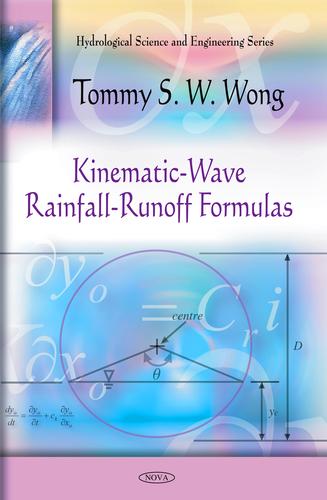
Kinematic-wave Rainfall-Runoff Formulas
0
0
As an Amazon Associate and affiliate partner, Menrva Books earns from qualifying purchases. Learn more
Author Description
This is not an ordinary book on rainfall and runoff. All the general and working formulas in this book are theoretically derived. The formulas are therefore globally and eternally applicable, as long as the situations under consideration are within the assumptions and limitations of the theory. This epitomises the powerful nature of the physically-based approach in hydrology. This book covers formulas for flow depth; flow velocity; average flow velocity; wave celerity; average wave celerity; time of concentration; rising, equilibrium and falling phases of a hydrograph; forward characteristic; rising, equilibrium and falling phases of water surface profiles; duration of partial equilibrium discharge; and equilibrium detention storage for flow on an overland plane, and flow in nine different channel shapes, which are circular, parabolic, rectangular (deep), rectangular (square), rectangular (wide), trapezoidal with equal side slopes, trapezoidal with one side vertical, triangular, and vertical curb.
Menrva's Summary
THE THESIS
This book presents a collection of theoretically derived kinematic-wave rainfall-runoff formulas. The author, Tommy S. W. Wong, emphasizes the universal applicability of these formulas, provided the conditions align with the underlying theoretical assumptions. This approach highlights the strength of physically-based modeling in hydrology. The book systematically covers a wide range of formulas essential for understanding water movement, including those for flow depth, velocity, time of concentration, and various phases of hydrographs and water surface profiles.
THE SCOPE MAP
- Formulas for flow depth, flow velocity, and average flow velocity.
- Formulas for wave celerity and average wave celerity.
- Formulas for time of concentration.
- Formulas for rising, equilibrium, and falling phases of a hydrograph.
- Formulas for forward characteristic.
- Formulas for rising, equilibrium, and falling phases of water surface profiles.
- Formulas for duration of partial equilibrium discharge.
- Formulas for equilibrium detention storage for flow on an overland plane and in nine different channel shapes (circular, parabolic, rectangular, trapezoidal, triangular, vertical curb).
THE AUTHORITY PERSPECTIVE
The Authority Perspective: This text offers a rigorous, physically-based approach to rainfall-runoff modeling, focusing on the derivation and application of kinematic-wave formulas. Its strength lies in the theoretical grounding of its equations, suggesting a comprehensive resource for advanced students and practicing hydrologists. The detailed coverage of various flow scenarios and channel geometries indicates a thorough exploration of the subject matter.
Page Count:
264
Publication Date:
2009-01-01
ISBN-10:
1606927051
ISBN-13:
9781606927052
Science
Non-Fiction
Water Resources
Engineering
Hydrology
Community Tags
Similar Books