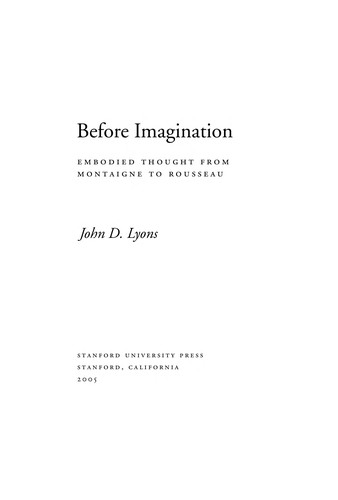
Before Imagination
0
0
As an Amazon Associate and affiliate partner, Menrva Books earns from qualifying purchases. Learn more
Author Description
This book seeks to understand what imagination meant in early modern Europe, and particularly in early modern France, before the Romantic era gave the term its modern meaning. The author explores the themes surrounding early modern notions of imagination (including hostility to imagination) through the writings of such figures as Descartes, Montaigne, Francois de Sales, Pascal, the Marquise de Sevigne, Madame de Lafayette, and Fenelon.--Jacket.
Menrva's Summary
THE THESIS
This book investigates the concept of imagination in early modern Europe, particularly in France, prior to the Romantic era's redefinition of the term. The author examines the multifaceted understanding of imagination, including prevalent skepticism and hostility towards it, by analyzing the works of key figures such as Descartes, Montaigne, Francois de Sales, Pascal, the Marquise de Sevigne, Madame de Lafayette, and Fenelon. The study focuses on the intellectual landscape of the period to trace the evolution of this crucial cognitive faculty.
THE SCOPE MAP
- Exploration of the meaning of imagination in early modern Europe, with a specific focus on France.
- Analysis of themes surrounding early modern notions of imagination, including periods of hostility towards it.
- Examination of writings from prominent figures like Descartes, Montaigne, Francois de Sales, Pascal, the Marquise de Sevigne, Madame de Lafayette, and Fenelon.
- Contextualization of the term 'imagination' before its modern meaning was established by the Romantic era.
- Discussion of the intellectual and philosophical currents that shaped the understanding of imagination.
THE AUTHORITY PERSPECTIVE
The book is likely to be of interest to scholars and students of early modern European intellectual history, French literature, and the history of philosophy. Its focus on a specific concept across a range of influential thinkers suggests a detailed and analytical approach. The examination of both the uses and hostilities towards imagination indicates a nuanced exploration of the topic.
Page Count:
282
Publication Date:
2006-01-01
ISBN-10:
0804751102
History
Non-Fiction
Philosophy
Literary Criticism
History of Ideas
French literature
Community Tags
Similar Books