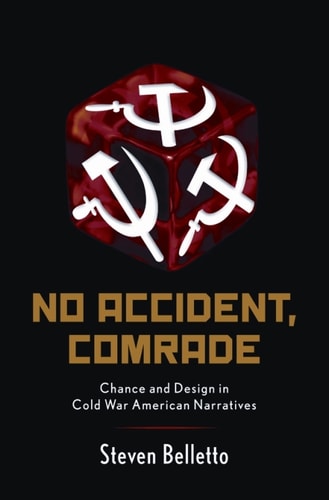
No Accident, Comrade: Chance and Design in Cold War American Narratives
0
0
As an Amazon Associate and affiliate partner, Menrva Books earns from qualifying purchases. Learn more
Author Description
No Accident, Comrade argues that chance became a complex yet conflicted cultural signifier during the Cold War, when a range of thinkers--politicians, novelists, historians, biologists, sociologists, and others--contended that totalitarianism denied the very existence and operation of chance in the world. They claimed that the USSR perpetrated a vast fiction on its population, a fiction amplified by the Soviet view that there is no such thing as chance or accident, only manifestations of historical law (hence the popular American refrain used to refer to Marxism: "It was no accident, Comrade").By reading an expansive range of American novels published between 1947-2005, alongside nonfiction texts by the likes of Jerzy Kosinski, Daniel Bell, Ian Hacking, and mid-century game theorists, No Accident, Comrade explains how associations of chance with democratic freedom and the denial of chance with totalitarianism circulated in Cold War America. Chance became tied to the liberties of U.S. democracy, whereas its eradication or denial became symptomatic of Soviet tyranny. With works by Nabokov, Ellison, Pynchon, Didion, DeLillo, Colson Whitehead, and many others, Steven Belletto shows how writers developed innovative strategies for dealing with and incorporating these ever-present beliefs about chance and its role in their culture. These newly developed narrative techniques allowed them to theorize, satirize, and make sense of the constantly changing relationship between the individual and the state during a largely rhetorical conflict.
Menrva's Summary
THE THESIS
This book investigates how the concept of chance functioned as a critical cultural signifier in Cold War America, serving as a binary marker to distinguish democratic freedom from totalitarian control. Steven Belletto, an academic specializing in American literature and culture, examines how mid-century thinkers and writers utilized the idea of randomness to counter the Soviet ideological insistence on historical determinism. By synthesizing literature with game theory, sociology, and political philosophy, the author argues that American narratives adopted chance as a mechanism to preserve individual agency against the perceived rigidity of state-mandated historical laws.
THE SCOPE MAP
What You Will Find
- Analysis of American novels published between 1947 and 2005.
- Integration of non-fiction texts by figures such as Jerzy Kosinski, Daniel Bell, and Ian Hacking.
- Examination of game theory and its influence on mid-century cultural rhetoric.
- Exploration of how authors like Nabokov, Pynchon, and DeLillo utilized narrative techniques to theorize the relationship between the individual and the state.
Scope Limits
- The study focuses primarily on American literary and intellectual responses rather than a comprehensive history of Soviet political theory.
- The analysis does not cover post-2005 developments in narrative theory or contemporary political discourse.
THE AUTHORITY PERSPECTIVE
Scholars and critics recognize this work as a rigorous contribution to the study of Cold War intellectual history and literary form. Readers frequently note the academic density of the prose, which effectively bridges the gap between political theory and literary analysis for advanced students of the period.
Page Count:
218
Publication Date:
2011-01-01
Publisher:
Oxford University Press
ISBN-10:
0190208562
ISBN-13:
9780190208561
History
Political Theory
Literary Criticism
History of the Americas
Customs & Traditions
Cold War
History of Ideas
English
American
Fiction political
English & College Success
Community Tags
Similar Books