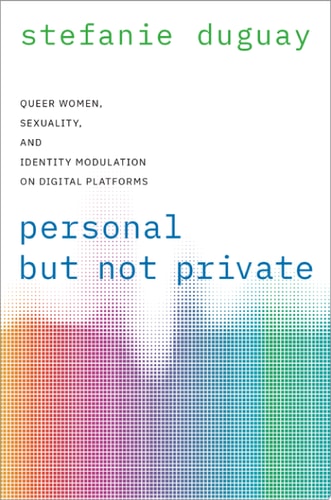
Personal but Not Private: Queer Women, Sexuality, and Identity Modulation on Digital Platforms
0
0
As an Amazon Associate and affiliate partner, Menrva Books earns from qualifying purchases. Learn more
Author Description
Privacy has become a pressing concern for many users of digital platforms who fear legal or social liability for sharing personal details online. Yet for queer women and others, an emphasis on privacy fails to reflect the creativity and struggles of everyday people seeking to represent themselves and form meaningful connections through social media.Personal but Not Private explores how queer women share and maintain their identities through digital technologies despite overlapping technological, social, economic, and political concerns. Focusing on representations of sexual identity through Tinder, Instagram, and Vine, this volume uncovers how queer women are continuously engaging in identity modulation, or the process through which people and platforms adjust or modify personal information, to form relationships, increase their social and economic participation, and counter intersecting forms of oppression. While queer women's representations of sexual identity give rise to publics and counterpublics through intimate and collective self-representation, platform-specific elements like design and governance place limitations on queer women's agency and often make them targets of censorship, harassment, and discrimination. This book also considers how identity modulation can be applied to a range of people negotiating digital contexts and promotes tangible changes to digital platforms and their broader social, economic, and political structures to empower individuals and their personal sharing on social media.Bringing together personal interviews and empirical research, Personal but Not Private offers a new lens for examining digitally mediated identities and highlights how platforms act as complicated sites of transformation.
Menrva's Summary
THE THESIS
This book investigates how queer women navigate the tension between personal expression and digital surveillance by employing identity modulation on social media platforms. Stefanie Duguay, a scholar in digital media and communication, utilizes a framework of identity modulation to analyze how individuals negotiate their sexual identities within the constraints of platform design. By synthesizing empirical research and personal interviews, the author argues that while digital spaces offer opportunities for community building, they simultaneously impose structural limitations that necessitate constant self-adjustment to avoid harassment and censorship.
THE SCOPE MAP
What You Will Find
- Analysis of identity modulation processes on Tinder, Instagram, and Vine.
- Examination of how platform governance and design influence user agency.
- Qualitative data derived from personal interviews with queer women.
- Theoretical exploration of publics and counterpublics in digital environments.
Scope Limits
- The study focuses primarily on specific platforms and may not account for newer or niche digital spaces.
- The research does not provide an exhaustive legal analysis of privacy policies across all global jurisdictions.
THE AUTHORITY PERSPECTIVE
Scholars in the field of digital sociology recognize this work as a significant contribution to the study of identity performance and platform politics. Readers frequently note the academic rigor of the text, which provides a nuanced understanding of how marginalized groups navigate the complexities of online visibility.
Page Count:
184
Publication Date:
2022-04-01
Publisher:
Oxford University Press
ISBN-10:
0190076186
ISBN-13:
9780190076184
Politics
Self-help
Sex
Engineering
Gender Studies
Sexual Health
Law
Professional Career & Trade
General Health
Communications
Communication
Social Aspects
Technology
Intellectual Property
Digital Media
Sociology
New Used & Rental Textbooks
Science & Math
Queer Studies
Sexuality
General
Community Tags
Similar Books