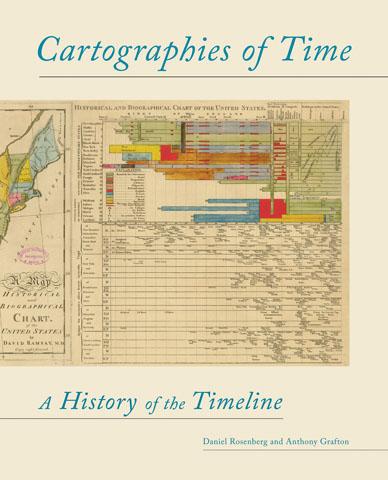
Cartographies of Time
0
0
As an Amazon Associate and affiliate partner, Menrva Books earns from qualifying purchases. Learn more
Author Description
**What does history look like? How do you draw time?** From the most ancient images to the contemporary, the line has served as the central figure in the representation of time. The linear metaphor is ubiquitous in everyday visual representations of time—in almanacs, calendars, charts, and graphs of all sorts. Even our everyday speech is filled with talk of time having a "before" and an "after" or being "long" and "short." The timeline is such a familiar part of our mental furniture that it is sometimes hard to remember that we invented it in the first place. And yet, in its modern form, the timeline is not even 250 years old. The story of what came before has never been fully told, until now. [*More at Princeton Press*][1]
Menrva's Summary
THE THESIS
How has humanity visualized the passage of time? This book investigates the historical development and visual representation of time, focusing on the ubiquitous use of the line as a metaphor. It traces the evolution of the timeline from ancient imagery to contemporary charts and graphs, revealing that this seemingly natural concept is a relatively recent invention, less than 250 years old in its modern form. The authors explore the origins and pervasive influence of linear time representation across various media and everyday language.
THE SCOPE MAP
- What You Will Find:
- The historical development of visual representations of time.
- The pervasive use and invention of the linear metaphor for time.
- Analysis of timelines, calendars, charts, and graphs across different eras.
- Exploration of how speech reflects linear conceptions of time.
- The origins of the modern timeline, dating back less than 250 years.
THE AUTHORITY PERSPECTIVE
The book examines the historical and visual construction of time, with a particular focus on the linear metaphor. It delves into how this concept, though seemingly intuitive, is a relatively recent invention that shapes our understanding and representation of history. The work likely appeals to those interested in visual culture, art history, and the philosophy of time.
Page Count:
272
Publication Date:
2009-01-01
ISBN-10:
1568987633
ISBN-13:
9781568987637
Philosophy
History
Non-Fiction
Art
Art History
Historiography
Visual Culture
Community Tags
Similar Books














