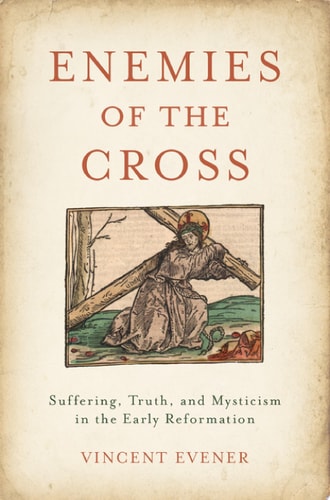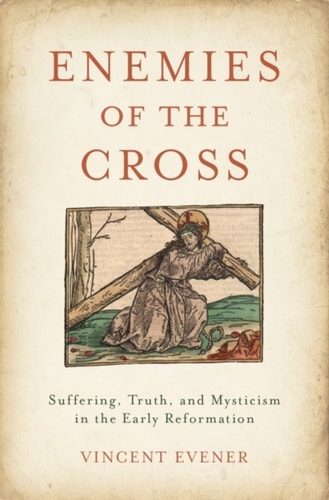
Enemies of the Cross
0
0
As an Amazon Associate and affiliate partner, Menrva Books earns from qualifying purchases. Learn more
Author Description
Enemies of the Cross examines how suffering and truth were aligned in the divisive debates of the early Reformation. Vincent Evener explores how Martin Luther, along with his first intra-Reformation critics, offered "true" suffering as a crucible that would allow believers to distinguish the truth or falsehood of doctrine, teachers, and their own experiences. To use suffering in this way, however, reformers also needed to teach Christians to recognize false suffering and the false teachers who hid under its mantle.This book contends that these arguments, which became an enduring part of the Lutheran and radical traditions, were nourished by the reception of a daring late-medieval mystical tradition — the post-Eckhartian — which depicted annihilation of the self as the way to union with God. The first intra-Reformation dissenters, Andreas Bodenstein von Karlstadt and Thomas Müntzer, have frequently been depicted as champions of medieval mystical views over and against the non-mystical Luther. Evener counters this depiction by showing how Luther, Karlstadt, and Müntzer developed their shared mystical tradition in diverse directions, while remaining united in the conviction that sinful self-assertion prevented human beings from receiving truth and living in union with God. He argues that Luther, Karlstadt, and Müntzer each represented a different form of ecclesial-political dissent shaped by a mystical understanding of how Christians were united to God through the destruction of self-assertion. Enemies of the Cross draws on seldom-used sources and proposes new concepts of "revaluation" and "relocation" to describe how Protestants and radicals brought medieval mystical teachings into new frameworks that rejected spiritual hierarchy.
Menrva's Summary
THE THESIS
This book investigates how early Reformation figures utilized the concept of suffering as a theological crucible to distinguish between authentic truth and doctrinal falsehood. Vincent Evener, a scholar of Reformation history, examines the intellectual intersection of late-medieval mysticism and the emerging Protestant tradition. By analyzing the writings of Martin Luther, Andreas Bodenstein von Karlstadt, and Thomas Müntzer, the author argues that these reformers shared a common mystical foundation centered on the annihilation of the self, which they adapted into distinct ecclesial and political frameworks.
THE SCOPE MAP
What You Will Find
- Analysis of post-Eckhartian mystical traditions and their influence on early Protestant thought.
- Comparative study of the theological development of Martin Luther, Karlstadt, and Müntzer.
- Introduction of the conceptual frameworks of 'revaluation' and 'relocation' regarding spiritual hierarchy.
- Examination of seldom-used primary sources from the early Reformation period.
Scope Limits
- The text focuses specifically on the intersection of mysticism and suffering rather than a comprehensive history of the entire Reformation movement.
- It does not provide an exhaustive biography of the figures mentioned, focusing instead on their specific theological contributions to the discourse on suffering.
THE AUTHORITY PERSPECTIVE
Scholars and historians recognize this work as a significant contribution to the study of Reformation-era theology and its medieval roots. Readers frequently note the academic density of the prose, which is intended for an audience familiar with historical theology and ecclesiastical history.
Page Count:
960
Publication Date:
2021-01-05
Publisher:
Oxford University Press Academic US
ISBN-10:
0190073195
ISBN-13:
9780190073190
Religion
History
17th Century
General
Social History
Mysticism
European History
Protestant
Social Sciences - Religion - Christianity
16th Century
Christian mysticism
Theology
Reformation
Community Tags
Similar Books