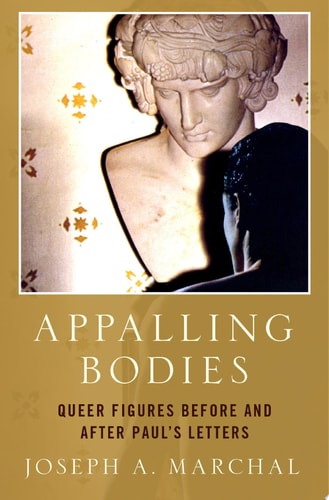
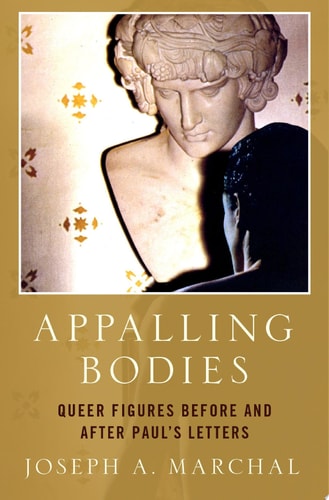
Appalling Bodies: Queer Figures Before and After Paul's Letters
0
0
As an Amazon Associate and affiliate partner, Menrva Books earns from qualifying purchases. Learn more
Author Description
The letters of Paul are among the most commonly cited biblical texts in ongoing cultural and religious disputes about gender, sexuality, and embodiment. Appalling Bodies reframes these uses of the letters by reaching past Paul toward other, far more fascinating figures that appear before, after, and within the letters. The letters repeat ancient stereotypes about women, eunuchs, slaves, and barbarians--in their Roman imperial setting, each of these overlapping groups were cast as debased, dangerous, and complicated.Joseph Marchal presents new ways for us to think about these dangers and complications with the help of queer theory. Appalling Bodies juxtaposes these ancient figures against recent figures of gender and sexual variation, in order to defamiliarize and reorient what can be known about both. The connections between the marginalization and stigmatization of these figures troubles the history, ethics, and politics of biblical interpretation. Ultimately, Marchal assembles and reintroduces us to Appalling Bodies from then and now, and the study of Paul's letters may never be the same.
Menrva's Summary
THE THESIS
How can the application of queer theory to the letters of Paul reveal the complex, often stigmatized identities of ancient figures and their modern counterparts? Joseph A. Marchal, a scholar of religion and biblical studies, utilizes a queer theoretical framework to analyze the intersection of gender, sexuality, and embodiment within the Roman imperial context of the Pauline epistles. By juxtaposing ancient stereotypes of women, eunuchs, slaves, and barbarians with contemporary figures of sexual and gender variation, the author challenges traditional methods of biblical interpretation and historical analysis.
THE SCOPE MAP
What You Will Find
- Analysis of ancient Roman imperial stereotypes regarding marginalized groups
- Application of queer theory to biblical hermeneutics
- Comparative study of ancient and modern figures of gender and sexual variation
- Critique of the ethics and politics of historical biblical interpretation
Scope Limits
- Does not provide a traditional theological commentary on the letters of Paul
- Does not focus on the historical biography of Paul himself, but rather the figures referenced within and around his texts
THE AUTHORITY PERSPECTIVE
Scholars in the field of biblical studies and queer theory recognize this work as a significant intervention in how ancient texts are read through modern identity lenses. Readers frequently note the academic density of the prose and the rigorous, theoretical nature of the author's arguments.
Page Count:
324
Publication Date:
2019-12-09
Publisher:
Oxford University Press
ISBN-10:
019006031X
ISBN-13:
9780190060312
Religion
Bible Study
Sex
Cultural History
Gender Studies
General
New Used & Rental Textbooks
Theology
Queer Theory
Commentaries
Community Tags
Other Editions(2)
Similar Books