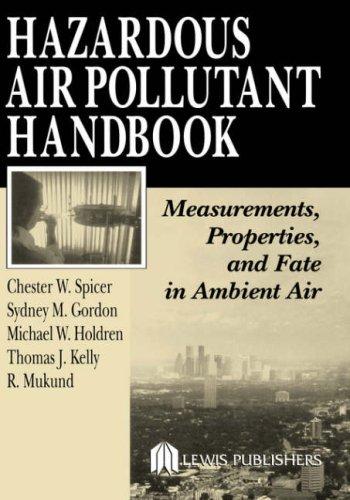
Hazardous Air Pollutant Handbook
0
0
As an Amazon Associate and affiliate partner, Menrva Books earns from qualifying purchases. Learn more
Author Description
Hazardous Air Pollutant Handbook: Measurements, Properties, and Fate in Ambient Air provides a comprehensive review of the 188 compounds and compound classes designated as Hazardous Air Pollutants (HAPs) by the Clean Air Act Amendments of 1990, with a specific focus on their potential presence in ambient air. The relevant chemical and physical properties of the compounds are discussed and tabulated and suitable methods for their measurement in ambient air are identified. A survey of measurements of ambient HAP concentrations is provided for use in historical comparisons and for evaluating the current human health risks from these chemicals. Finally, the book reviews the atmospheric reactions that control the lifetime and fate of the HAPs in ambient air and summarizes the current knowledge of their transformation products.--BOOK JACKET.
Menrva's Summary
THE THESIS
This handbook addresses the measurement, properties, and environmental fate of Hazardous Air Pollutants (HAPs) as defined by the Clean Air Act Amendments of 1990. It offers a detailed examination of the 188 designated compounds and compound classes, with a particular emphasis on their presence in ambient air. The text compiles and discusses essential chemical and physical properties, identifies appropriate measurement methodologies for ambient air, and presents a survey of existing concentration measurements for historical and risk assessment purposes. Furthermore, it explores the atmospheric reactions governing HAP lifetimes and transformations, summarizing current knowledge on their breakdown products.
THE SCOPE MAP
- Detailed review of 188 compounds and compound classes designated as Hazardous Air Pollutants (HAPs).
- Focus on the potential presence and measurement of HAPs in ambient air.
- Tabulated chemical and physical properties of the HAPs.
- Identification of suitable methods for measuring HAPs in ambient air.
- Survey of ambient HAP concentration measurements for historical comparison and risk evaluation.
- Review of atmospheric reactions controlling HAP lifetime and fate.
- Summary of current knowledge on HAP transformation products.
THE AUTHORITY PERSPECTIVE
This handbook is a technical reference work aimed at professionals and researchers in environmental science and public health. Its comprehensive nature, covering properties, measurement, and atmospheric fate, suggests it serves as a valuable resource for understanding and managing hazardous air pollutants. The detailed focus on specific compounds and their behavior in ambient air indicates a rigorous, data-driven approach. The inclusion of measurement surveys and reaction pathways points to its utility for both current risk assessment and historical environmental analysis.
Page Count:
240
Publication Date:
2002-01-01
ISBN-10:
1566705711
ISBN-13:
9781566705714
Non-Fiction
Science
Chemistry
Reference
Public Health
Community Tags
Similar Books