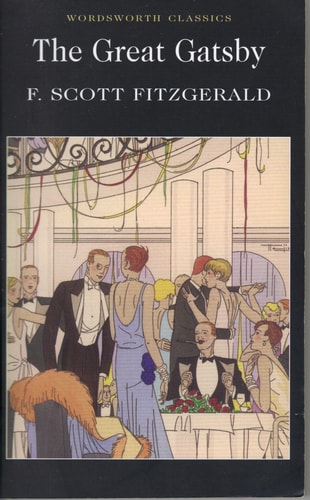
The Great Gatsby
0
0
As an Amazon Associate and affiliate partner, Menrva Books earns from qualifying purchases. Learn more
Author Description
Here is a novel, glamorous, ironical, compassionate – a marvelous fusion into unity of the curious incongruities of the life of the period – which reveals a hero like no other – one who could live at no other time and in no other place. But he will live as a character, we surmise, as long as the memory of any reader lasts. "There was something gorgeous about him, some heightened sensitivity to the promises of life.... It was an extraordinary gift for hope, a romantic readiness such as I have never found in any other person and which it is not likely I shall ever find again." It is the story of this Jay Gatsby who came so mysteriously to West Egg, of his sumptuous entertainments, and of his love for Daisy Buchanan – a story that ranges from pure lyrical beauty to sheer brutal realism, and is infused with a sense of the strangeness of human circumstance in a heedless universe. It is a magical, living book, blended of irony, romance, and mysticism. --first edition jacket ---------- Also contained in: - [The Fitzgerald Reader](https://openlibrary.org/works/OL468551W/The_Fitzgerald_Reader) - [Three Novels of F. Scott Fitzgerald ](https://openlibrary.org/works/OL468557W)
Menrva's Summary
THE PULSE
The arrival of the enigmatic Jay Gatsby in West Egg triggers a series of events that expose the moral decay and social stratification of the American Jazz Age. Nick Carraway, a newcomer to the affluent enclave of Long Island, observes the extravagant lifestyle of his neighbor, Gatsby, whose singular objective is to reclaim a past romance with the married Daisy Buchanan. The narrative framework utilizes Nick as a first-person observer, providing a filtered perspective on the reckless behavior of the wealthy elite. The story operates within the rigid social constraints of the 1920s, where class status and inherited wealth dictate the boundaries of personal agency.
INSIDE THE PAGES
- First-person retrospective narration by Nick Carraway
- Symbolic use of the green light and the Valley of Ashes
- Exploration of the American Dream and its inherent corruption
- Contrast between the established aristocracy of East Egg and the nouveau riche of West Egg
- Lyrical, descriptive prose style characteristic of the period
- Non-linear elements through the use of flashbacks to Gatsby's past
- Focus on themes of obsession, social mobility, and disillusionment
- Intricate character studies of the Buchanans and their social circle
THE COLLECTIVE ECHO
Discussion often centers on the efficacy of Nick Carraway as an unreliable narrator who attempts to maintain objectivity while being drawn into the lives of the wealthy. Readers frequently highlight the stark contrast between the opulent, hedonistic parties and the underlying emptiness of the characters' lives. Critics often examine the text as a critique of the American Dream, noting how the pursuit of material success frequently leads to moral compromise. The prose is widely recognized for its rhythmic quality and its ability to capture the specific atmosphere of the 1920s with precision. Many readers find the brevity of the novel allows for repeated analysis of its dense symbolism and thematic depth.
Page Count:
193
Publication Date:
1992-06-12
Publisher:
Scribner Paper Fiction
ISBN-10:
0020198825
ISBN-13:
9780020198826
Literary Fiction
Social Commentary
First loves
Historical
Revenge
Mistresses
classic
Jazz Age
Married Women
Rich People
Long Island NY -- Fiction