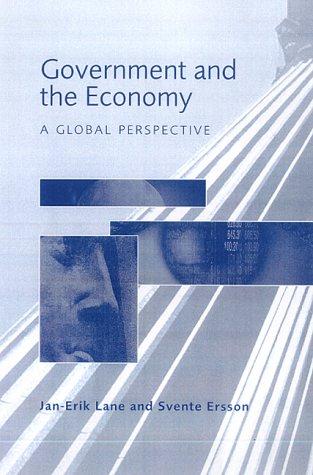
Government and the Economy
0
0
As an Amazon Associate and affiliate partner, Menrva Books earns from qualifying purchases. Learn more
Author Description
Globalization is a common theme in the discourse of post-industrial society, yet it is a process that is ill understood. Is it basically a technological phenomenon or does its immense impulse derive from economic factors? Should it be regulated by government, and at what level? Questions such as these are debated continuously in the mass media, yet there are no simple answers available, as globalization is not only an amporphous but also a contested phenomenon.Government and the Economy is a completely reworked edition of Jan-Erik Lane and Svante Ersson's popular text Comparative Political Economy, which the authors have updated for the twenty-first century. They present a profound analysis of how globalization changes the boundaries between state and market, public and private, and government and society. When the state retreats and markets expand, what are the major outcomes? And what is driving this process of redefining the roles of government and the tasks of society?The book offers a penetrating survey of the differences between the countries of the world in terms of their economy and polity, and a forceful critique of the prevailing models in political economy. Lane and Ersson look closely at Public Choice theories which emphasize the role of markets in accomplishing efficient solutions to human interaction while modeling governments as enhancing state failure. They argue that such accounts are misguided. The need for govenment in the global market economy is as strong as it is in relation to the domestic economy. They go on to suggest that the most efficient and equitable means of strengthening government in the global market place, without creating one-world government, is the reform and empowerment of IGOs.--Bloomsbury Publishing.
Menrva's Summary
THE THESIS
This book investigates the complex and often misunderstood phenomenon of globalization and its intricate relationship with governmental and economic structures. It analyzes how globalization redefines the boundaries between the state and the market, the public and private sectors, and government and society, exploring the consequences of retreating states and expanding markets. The authors critique prevailing political economy models, particularly Public Choice theories, arguing that they underestimate the essential role of government in a globalized economy. Ultimately, the book proposes reforms and empowerment of International Governmental Organizations (IGOs) as the most effective means to strengthen governance in the global market without resorting to a one-world government.
THE SCOPE MAP
- Analysis of globalization as a technological and economic phenomenon.
- Examination of the changing roles of government and market in a globalized world.
- Critique of Public Choice theories and their emphasis on state failure.
- Argument for the continued necessity of government in the global market economy.
- Discussion on the reform and empowerment of International Governmental Organizations (IGOs).
- Comparative survey of economic and political differences across countries.
THE AUTHORITY PERSPECTIVE
The book offers a critical examination of globalization, challenging conventional wisdom and prevailing economic models. It is noted for its in-depth analysis of the evolving relationship between government and the economy in the context of increasing global interconnectedness. The authors' critique of Public Choice theories and their advocacy for strengthening IGOs provide a distinct perspective on managing global economic forces. This work is positioned as a significant contribution to understanding the complexities of contemporary political economy.
Page Count:
338
Publication Date:
2002-01-01
ISBN-10:
0826454925
ISBN-13:
9780826454928
Politics
Economics
Non-Fiction
Globalization
Community Tags
Similar Books