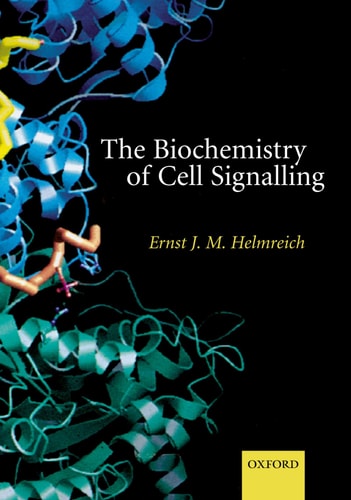
The Biochemistry of Cell Signalling
0
0
As an Amazon Associate and affiliate partner, Menrva Books earns from qualifying purchases. Learn more
Author Description
The Biochemistry of Cell Signalling deals in depth with the principles of cell signalling, concentrating on structure and mechanism. It will serve as a reliable map through the maze of cell signalling pathways and help the reader understand how malfunctions in these pathways can lead to disease. The book is divided into four parts. Part 1 describes the machinery of signal transduction starting with the properties of signals, receptors (including receptor activation), regulators, and the molecules that link receptor and regulator. The design of signalling cascades is explained by describing central signalling pathways: the Ras-regulated MAPK and PI-3 pathways; the Rho/Rac/Cdc 42 pathway controlling chemotaxis and regulating the cytoskeleton; the G protein coupled receptor cascades in response to sensory and hormonal signals; signalling by TGF-ß in morphogenesis; cytokine signalling that controls haemopoiesis. There is also a discussion of the insulin response. As phosphorylation - dephosphorylation is involved in nearly all cellular regulatory processes, Part 1 concludes with a synopsis of its role in signalling. Part 2 describes the implementation of the signalling cascades focusing on the effect on gene transcription. After a brief description of the transcriptional machinery the regulation of transcription by cytokines and growth factors in the control of cell growth and the mechanisms and sites of control are discussed in detail. The regulators discussed include Jun/Fos, NF-AT, SREBPs, and STATs. The next two chapters cover gene regulation by nuclear receptors, including both the steroid hormone receptors and non-steroid nuclear receptors e.g. the retinoic acid receptors RAR and RXR. Part 3 studies the global cellular regulatory programs for the control of cell growth and proliferation. The first chapter concerns the regulation of the cell cycle and the role of the cyclin-dependent kinases, telomerase, Ran, and cell cycle checkpoints. The next topic is the signal
Menrva's Summary
THE THESIS
This text investigates the fundamental biochemical principles and structural mechanisms that govern cellular signal transduction pathways. Ernst J. M. Helmreich, an established authority in biochemistry, synthesizes complex molecular data to provide a structured framework for understanding how cells receive, process, and respond to external signals. The book systematically explores the machinery of transduction, the regulation of gene expression, and the global regulatory programs that dictate cell growth and proliferation.
THE SCOPE MAP
What You Will Find
- Detailed analysis of signal transduction machinery including receptors, regulators, and linking molecules.
- Examination of central signalling pathways such as Ras-regulated MAPK, PI-3, and G protein coupled receptor cascades.
- Exploration of transcriptional regulation mechanisms involving cytokines, growth factors, and nuclear receptors.
- Comprehensive overview of cell cycle control, including the role of cyclin-dependent kinases and telomerase.
THE AUTHORITY PERSPECTIVE
Experts and students in the field recognize this work as a rigorous, high-level reference for understanding the molecular basis of cell signalling. Readers frequently note the academic density of the prose, which serves as a foundational resource for those studying the biochemical origins of disease states.
Page Count:
368
Publication Date:
2001-09-13
Publisher:
Oxford University Press
ISBN-10:
0198508204
ISBN-13:
9780198508205
Science
Medicine
Cell Biology
Biochemistry
textbook
Community Tags
Other Editions(2)
Similar Books








Reader Comments
Share Your Thoughts
No comments yet. Be the first to share your thoughts!