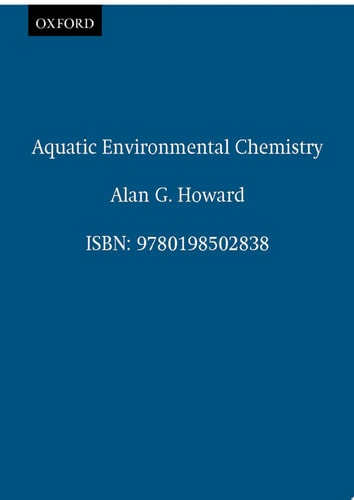
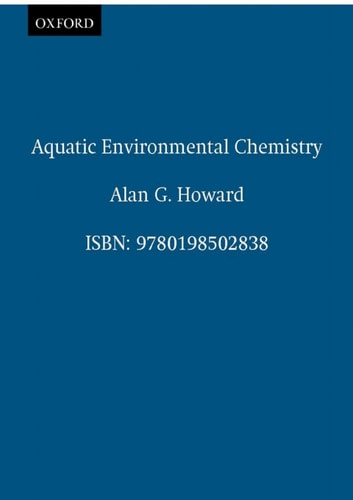
Aquatic Environmental Chemistry
0
0
As an Amazon Associate and affiliate partner, Menrva Books earns from qualifying purchases. Learn more
Author Description
Equilibrium inorganic chemistry underlies the composition and properties of the aquatic environment and provides a sound basis for understanding both natural geochemical processes and the behavior of inorganic pollutants in the environment. Designed for readers having basic chemical and mathematical knowledge, this book includes material and examples suitable for undergraduate students in the early stages of chemistry, environmental science, geology, irrigation science and oceanography courses. Aquatic Environmental Chemistry covers the composition and underlying properties of both freshwater and marine systems and, within this framework, explains the effects of acidity, complexation, oxidation and reduction processes, and sedimentation. The format adopted for the book consists of two parallel columns. The inner column is the main body of the book and can be read on its own. The outer column is a source of useful secondary material where comments on the main text, explanations of unusual terms and guidance through mathematical steps are to be found. A wide range of examples to explain the behavior of inorganic species in freshwater and marine systems are used throughout, making this clear and progressive text an invaluable introduction to equilibrium chemistry in solution.
Menrva's Summary
THE THESIS
This book investigates how equilibrium inorganic chemistry dictates the composition and behavior of aquatic environments, including natural geochemical processes and the movement of pollutants. Alan G. Howard, leveraging his expertise in chemical science, constructs a framework that bridges fundamental chemical principles with practical environmental applications. The text is designed for undergraduate students in fields such as geology and oceanography, providing a structured approach to understanding complex solution chemistry through clear, progressive examples.
THE SCOPE MAP
What You Will Find
- Analysis of freshwater and marine system compositions
- Examination of acidity, complexation, and oxidation-reduction processes
- Dual-column pedagogical format for primary text and secondary mathematical guidance
- Application of equilibrium chemistry to inorganic pollutant behavior
THE AUTHORITY PERSPECTIVE
Experts and educators frequently cite this primer as a foundational resource for students requiring a bridge between basic chemistry and environmental applications. Readers often note the effectiveness of the dual-column layout in clarifying complex mathematical steps and terminology for those new to the subject.
Page Count:
96
Publication Date:
1998-11-12
Publisher:
Oxford University Press
ISBN-10:
0198502834
ISBN-13:
9780198502838
Water Chemistry
Textbooks
Chemistry
Geology
Oceanography
Community Tags
Other Editions(2)
Similar Books