Introduction to Distance Sampling: Estimating Abundance of Biological Populations
0
0
As an Amazon Associate and affiliate partner, Menrva Books earns from qualifying purchases. Learn more
Author Description
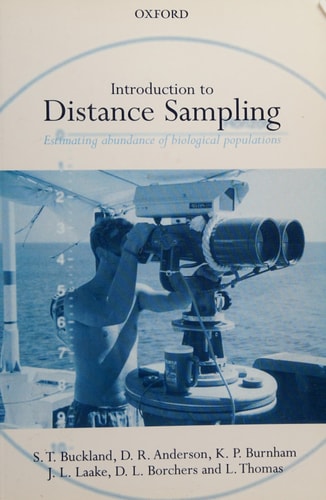
Product DescriptionOffers a comprehensive introduction to distance sampling, a statistical method used by many biologists and conservationists to estimate animal abundance. The text discusses point transect sampling and line transect sampling and also describes several other related techniques. There are updateson study design and field methods, laser range finders, theodolites and the GPS and advice is given on a wide range of survey methods. Analysis methods have also been generalized, through the use of various types of multiplier and exercises for students in wildlife and conservation management areincluded.About the AuthorSteven Buckland, University of St Andrews. David Anderson, Colorado Cooperative Fish and Wildlife Research Unit, Colorado. Ken Burnham, Colorado Cooperative Fish and Wildlife Research Unit, Colorado.
Menrva's Summary
THE THESIS
This text investigates the statistical methodologies required to accurately estimate the abundance and density of biological populations using distance sampling techniques. The authors, a team of prominent researchers in wildlife biology and quantitative ecology, provide a rigorous framework for applying point and line transect sampling. By integrating theoretical statistical models with practical field application, the book establishes a standardized approach for conservationists and biologists tasked with monitoring animal populations in diverse environments.
THE SCOPE MAP
What You Will Find
- Comprehensive coverage of point transect and line transect sampling methodologies.
- Technical guidance on modern field equipment including laser range finders, theodolites, and GPS integration.
- Statistical analysis frameworks utilizing multipliers for population estimation.
- Practical exercises designed for students and professionals in wildlife and conservation management.
THE AUTHORITY PERSPECTIVE
Experts recognize this work as a foundational technical manual for researchers engaged in population monitoring. Readers frequently note the high level of statistical density, making it a primary reference for those requiring precise mathematical rigor in ecological field studies.
Page Count:
448
Publication Date:
2001-11-01
Publisher:
Oxford University Press
ISBN-10:
019850649X
ISBN-13:
9780198506492
Science
Statistics
Ecology
Biology
Conservation
Sampling statistics
Community Tags
Similar Books