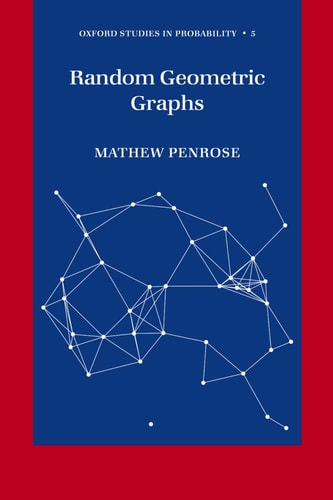
Random Geometric Graphs
0
0
As an Amazon Associate and affiliate partner, Menrva Books earns from qualifying purchases. Learn more
Author Description
This monograph provides and explains the mathematics behind geometric graph theory, which studies the properties of a graph that consists of nodes placed in Euclidean space so that edges can be added to connect points that are close to one another. For example, a collection of trees scattered in a forest and the disease that is passed between them, a set of nests of animals or birds on a region and the communication between them or communication between communications stations or nerve cells. Aimed at graduate students and researchers in probability, statistics, combinatorics and graph theory including computer scientists, it covers topics such as: technical tools, edge and component counts, vertex degrees, clique and chromatic number, and connectivity. Applications of this theory are used in the study of neural networks, spread of disease, astrophysics and spatial statistics.
Menrva's Summary
THE THESIS
This monograph investigates the mathematical foundations and probabilistic properties of geometric graphs where nodes are distributed within Euclidean space. Author Mathew D. Penrose provides a rigorous framework for understanding how spatial proximity influences connectivity and network behavior. By synthesizing techniques from probability theory and combinatorics, the text establishes a formal basis for analyzing complex systems ranging from biological networks to communication infrastructures.
THE SCOPE MAP
What You Will Find
- Technical tools for analyzing edge counts, component distribution, and vertex degrees.
- Mathematical models for clique numbers, chromatic numbers, and global connectivity.
- Applications in neural networks, spatial statistics, and the modeling of disease transmission.
- Theoretical derivations relevant to astrophysics and communication station placement.
THE AUTHORITY PERSPECTIVE
Experts recognize this work as a foundational text for graduate-level research in spatial probability and graph theory. Readers frequently note the high level of technical density, making it a primary resource for those specializing in the intersection of statistics and network science.
Page Count:
344
Publication Date:
2003-07-03
Publisher:
Oxford University Press
ISBN-10:
0198506260
ISBN-13:
9780198506263
Probability
Graph Theory
Mathematics
Computer Science
Statistics
Community Tags
Similar Books