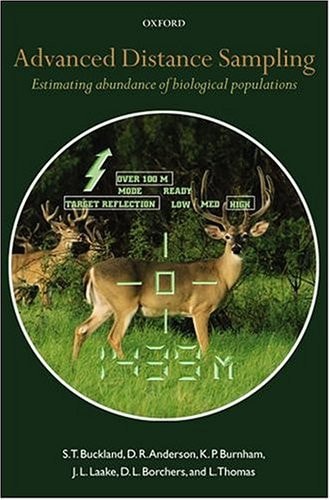
Advanced Distance Sampling: Estimating Abundance of Biological Populations
0
0
As an Amazon Associate and affiliate partner, Menrva Books earns from qualifying purchases. Learn more
Author Description
This advanced text focuses on the uses of distance sampling to estimate the density and abundance of biological populations. It addresses new methodologies, new technologies and recent developments in statistical theory and is the follow-up companion to Introduction to Distance Sampling (OUP, 2001). In this text, a general theoretical basis is established for methods of estimating animal abundance from sighting surveys, and a wide range of approaches to the design and analysis of distance sampling surveys is explored. These approaches include: modelling animal detectability as a function of covariates, where the effects of habitat, observer, weather, etc. on detectability can be assessed; estimating animal density as a function of location, allowing for example animal density to be related to habitat and other locational covariates; estimating change over time in population abundance, a necessary aspect of any monitoring programme; estimation when detection of animals on the line or at the point is uncertain, as often occurs for marine populations, or when the survey region has dense cover; automated generation of survey designs, using geographic information systems; adaptive distance sampling methods, which concentrate survey effort in areas of high animal density; passive distance sampling methods, which extend the application of distance sampling to species that cannot be readily detected in sightings surveys, but can be trapped; and testing of methods by simulation, so the performance of the approach in varying circumstances can be assessed. Authored by a leading team, this text is aimed at professionals in government and environment agencies, statisticians, biologists, wildlife managers, conservation biologists and ecologists, as well as graduate students, studying the density and abundance of biological populations.
Menrva's Summary
THE THESIS
This text investigates the advanced statistical methodologies required to accurately estimate the density and abundance of biological populations using distance sampling techniques. The authors, a team of leading experts in the field, build upon foundational concepts to address complex variables such as habitat, observer bias, and weather conditions. By establishing a rigorous theoretical framework, the book provides a comprehensive guide for applying these methods to diverse environmental monitoring scenarios.
THE SCOPE MAP
What You Will Find
- Advanced statistical modeling of animal detectability using covariates.
- Methodologies for estimating density as a function of spatial location.
- Techniques for monitoring population changes over time.
- Integration of geographic information systems for automated survey design.
- Adaptive and passive sampling strategies for challenging environments.
- Simulation-based testing protocols to assess performance in varying conditions.
THE AUTHORITY PERSPECTIVE
Experts recognize this work as a critical follow-up to foundational texts, serving as a primary resource for professionals and graduate students in ecology and statistics. Readers frequently note the high level of technical density, which requires a strong background in statistical theory to fully implement the proposed methodologies.
Page Count:
434
Publication Date:
2004-11-04
Publisher:
Oxford University Press
ISBN-10:
0198507836
ISBN-13:
9780198507833
Science
Statistics
Sampling statistics
Biology
Ecology
Mathematics
Community Tags
Similar Books






Reader Comments
Share Your Thoughts
No comments yet. Be the first to share your thoughts!