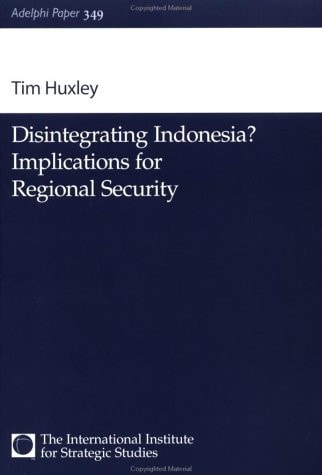
Disintegrating Indonesia?: Implications for Regional Security
0
0
As an Amazon Associate and affiliate partner, Menrva Books earns from qualifying purchases. Learn more
Author Description
Since the collapse of President Suharto's New Order regime in 1998 and the international intervention in East Timor in 1999, there has been much speculation in South-east Asia and the West over whether Indonesia - weakened by economic difficulties, social distresses and political instability - has a future as a coherent nation-state. This paper argues that although the separatist struggles in Aceh or Papua are unlikely to suceed in the foreseeable future, other problems threaten to undermine the central government's control.Communal disputes have led to chronic violence in Maluku, Central Sulawesi, and Kalimantan. Simultaneously, tension between Islamic and secular political forces has grown. Indonesia's disarray has prompted international concern over an array of security threats, including contagious secessionism, Islamic terrorism, the movement through Indonesia of asylum-seekers, piracy and environmental dangers. In order to contain these security implications of Indonesia's protracted crisis, concerned governments should continue assisting its fragile reform process, particularly by helping Jakarta to manage the country's massive international debt. However, they should also coordinate their contingency planning for a further crumbling of Jakarta's authority.
Menrva's Summary
THE THESIS
This paper investigates whether the post-Suharto era of instability in Indonesia poses a terminal threat to its existence as a coherent nation-state. Tim Huxley, a specialist in Southeast Asian security, utilizes a geopolitical framework to analyze the intersection of internal domestic crises and their broader implications for regional stability. He argues that while total state collapse is not immediate, the erosion of central authority necessitates a dual-track international response of supporting reform while preparing for potential fragmentation.
THE SCOPE MAP
What You Will Find
- Analysis of separatist movements in Aceh and Papua.
- Examination of communal violence in Maluku, Central Sulawesi, and Kalimantan.
- Assessment of transnational security threats including Islamic terrorism, piracy, and asylum-seeker migration.
- Strategic recommendations for international governments regarding debt management and contingency planning.
THE AUTHORITY PERSPECTIVE
Experts recognize this work as a critical snapshot of the security climate in Southeast Asia during the late 1990s and early 2000s. Readers frequently note the clarity of the author's geopolitical assessment and the practical focus on regional policy implications.
Page Count:
112
Publication Date:
2005-02-15
Publisher:
Routledge
ISBN-10:
0198516681
ISBN-13:
9780198516682
History
Indonesia
Security Studies
Southeast Asia
International relations
Community Tags
Similar Books