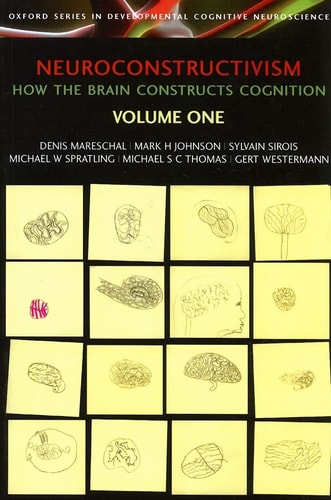
Neuroconstructivism: How the Brain Constructs Cognition
0
0
As an Amazon Associate and affiliate partner, Menrva Books earns from qualifying purchases. Learn more
Author Description
What are the processes, from conception to adulthood, that enable a single cell to grow into a sentient adult? They are so complex that any attempt to understand development necessitates a multi-disciplinary approach, integrating data from cognitive studies, computational modeling, and neuroimagingan approach until now seldom taken when considering child development. Neuroconstructivism is a major two-volume work that seeks to redress this balance, presenting an integrative new framework for considering development. In Volume One, the authors review up-to-date findings from neurobiology, brain imaging, child development, as well computer and robotic modeling to consider why children's thinking develops the way it does, and propose a new synthesis of development that is based on five key principles found to operate at many different levels of description. Their Neuroconstructivist framework also shows how developmental disorders, such as dyslexia, can arise from typical developmental processes operating under atypical constraints. Of central importance to Neuroconstructivism is the idea that computer and robotic models are vital tools for investigating the processes and mechanisms involved in learning and development. Volume Two illustrates the principles of Neuroconstructivist development through contributions from nine different labs across the world.
Menrva's Summary
THE THESIS
This work investigates the complex biological and computational processes that enable a single cell to develop into a sentient adult brain. The authors, a team of experts in cognitive neuroscience and computational modeling, argue that child development must be studied through a multi-disciplinary lens. They propose a new Neuroconstructivist framework based on five key principles, which explains how cognitive structures emerge from the interaction between neurobiology, environmental constraints, and developmental mechanisms.
THE SCOPE MAP
What You Will Find
- An integrative framework combining neurobiology, brain imaging, and child development data.
- Application of computational and robotic modeling to simulate learning mechanisms.
- Analysis of developmental disorders, such as dyslexia, viewed through the lens of atypical constraints.
- A synthesis of five core principles governing cognitive development from conception to adulthood.
THE AUTHORITY PERSPECTIVE
Experts recognize this text as a foundational contribution to the field of developmental cognitive neuroscience due to its rigorous interdisciplinary approach. Readers frequently note the academic density of the prose, which is intended for researchers and advanced students seeking a comprehensive model of brain development.
Page Count:
288
Publication Date:
2007-03-15
Publisher:
Oxford University Press
ISBN-10:
0198529910
ISBN-13:
9780198529910
Psychology
Science
Neuroscience
Developmental Psychology
Community Tags
Similar Books