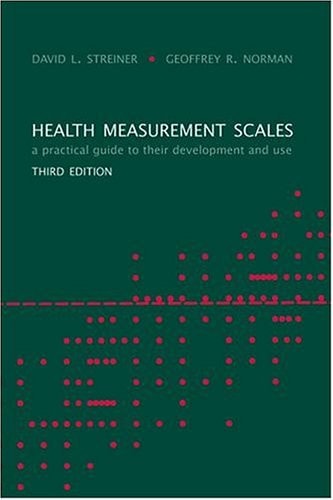
Health Measurement Scales: A Practical Guide to Their Development and Use
0
0
As an Amazon Associate and affiliate partner, Menrva Books earns from qualifying purchases. Learn more
Author Description
This is the new edition of the highly successful practical guide for clinicians developing tools to measure subjective states, attitudes or non-tangible outcomes in their patients. It is widely used by people from many disciplines, who have only a limited knowledge of statistics.This thoroughly updated edition of Health Measurement Scales 3e gives more details on cognitive requirements in answering questions, and how this influences scale development. There is now an expanded discussion of generizibility theory, a completely revised chapter on Item Response Theory and many revisions are included, based on the latest research findings.These features combine to provide the most up-to-date guide to measuring scale development available. It synthesizes the theory of scale construction with practical advice, culled from the literature and the authors' experience, about how to develop and validate measurement scales to be used in the health sciences. The theory goes into issues of reliability, generalizability theroy, validity, the measurement of change, the cognitive requirements of answering questions, and item response theory. Practical issues cover devising the items, biases that may affect the responses, pre-testing and weeding our poorly performing items, combining items into scales, setting cut points, and the practical issues of using scales in various ways, such as face-to-face interviews; mailed or telephone-administered surveys; and over the internet. One chapter also discusses some of the ethical issues that scale developers and users should be aware of. Appendices lead the reader to other readings; sources of already developed scales and items; and a very brief introduction to exploratory and confirmatory factor analysis.
Menrva's Summary
THE THESIS
How can clinicians and researchers effectively construct and validate measurement scales for subjective health outcomes? Professors Geoffrey R. Norman and David L. Streiner provide a comprehensive framework for developing tools that quantify non-tangible patient states, such as attitudes or quality of life. The text synthesizes psychometric theory with applied methodology, specifically designed for practitioners who possess limited formal training in advanced statistics.
THE SCOPE MAP
What You Will Find
- Detailed methodologies for item development, pre-testing, and scale validation.
- Advanced theoretical frameworks including Generalizability Theory and Item Response Theory.
- Practical guidance on administrative modes, including face-to-face, telephone, and internet-based surveys.
- Analysis of cognitive requirements in respondent behavior and potential response biases.
THE AUTHORITY PERSPECTIVE
Experts recognize this text as a foundational resource for health professionals tasked with instrument development. Readers frequently note the balance between rigorous theoretical discussion and accessible, practical advice for non-statisticians.
Page Count:
296
Publication Date:
2003-12-18
Publisher:
Oxford University Press
ISBN-10:
0198528477
ISBN-13:
9780198528470
Psychology
Medical
Research Methods
Statistics
Health Sciences
Health Surveys
Community Tags
Other Editions(2)
Similar Books











Reader Comments
Share Your Thoughts
No comments yet. Be the first to share your thoughts!