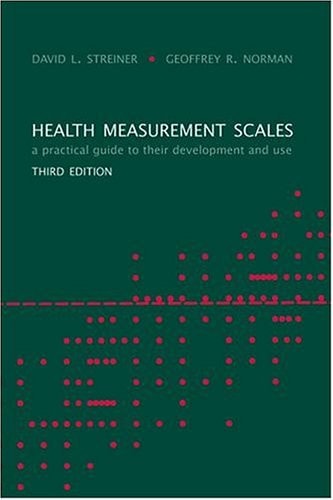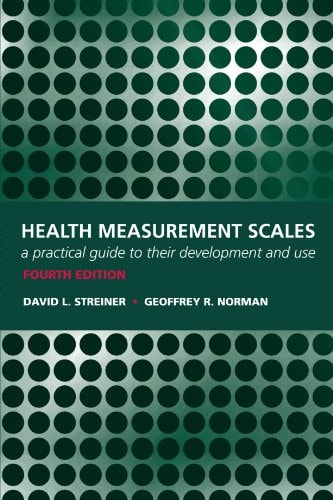
Health Measurement Scales: A Practical Guide to Their Development and Use
0
0
As an Amazon Associate and affiliate partner, Menrva Books earns from qualifying purchases. Learn more
Author Description
Clinicians and those in health sciences are frequently called upon to measure subjective states such as attitudes, feelings, quality of life, educational achievement and aptitude, and learning style in their patients. This fourth edition of Health Measurement Scales enables these groups who often have limited knowledge of statistics, to both develop scales to measure non-tangible health outcomes, and better evaluate and differentiate between existing tools.It covers how the individual items are developed; various biases that can affect responses (eg social desirability, yea-saying, framing); various response options; how to select the best items in the set; how to combine them into a scale; and then how to determine the reliability and validity of the scale. It concludes with a discussion of ethical issues that may be encountered, and guidelines for reporting the results of the scale development process. Appendices include a comprehensive guide to finding existing scales, and a brief introduction to exploratory and confirmatory factor analysis. It synthesizes the theory of scale construction with practical advice, making it the ultimate guide to how to develop and validate measurement scales that are to be used in the health sciences.
Menrva's Summary
THE THESIS
This text addresses the methodological challenge of quantifying subjective health states, such as quality of life and patient attitudes, through the rigorous development and validation of measurement scales. Authors Geoffrey R. Norman and David L. Streiner provide a structured framework for clinicians and health science researchers who may lack extensive statistical training. The book synthesizes psychometric theory with applied techniques, guiding the reader from the initial conceptualization of items to the final assessment of a scale's reliability and validity.
THE SCOPE MAP
What You Will Find
- Methodologies for item development and selection to measure non-tangible health outcomes.
- Analysis of response biases including social desirability, framing effects, and acquiescence.
- Statistical procedures for evaluating reliability, validity, and factor analysis.
- Ethical considerations and standardized guidelines for reporting scale development results.
THE AUTHORITY PERSPECTIVE
Experts and academics frequently cite this work as a foundational resource for health science professionals tasked with instrument design. Readers often note the balance between accessible prose and the technical rigor required for valid psychometric research.
Page Count:
431
Publication Date:
2008-12-15
Publisher:
Oxford University Press
ISBN-10:
0199231885
ISBN-13:
9780199231881
Health
Science
Psychometrics
Health Surveys
Research Methods
Medicine
Statistics