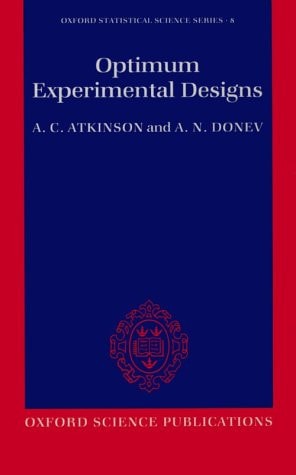
Optimum Experimental Designs
0
0
As an Amazon Associate and affiliate partner, Menrva Books earns from qualifying purchases. Learn more
Author Description
A well-designed experiment is an efficient method for learning about the physical world, however since experiments in any setting cannot avoid random error, statistical methods are essential for their design and implementation, and for the analysis of results. In this book, the fundamentals of optimum experimental design theory are presented. In the first part, the advantages of a statistical approach to the design of experiments are discussed, and the ideas of models, least squares fitting, and optimum experimental designs are introduced. The second part presents a more detailed discussion of the general theory of optimum design and an evaluation of various criteria that may be appropriate for designing experiments. Specific experiments are detailed and algorithms for the construction of designs are given. Each chapter is a self-contained, illustrated with examples drawn from science and engineering. Little previous statistical knowledge is assumed, and the derivation of mathematical results has been avoided. This book should be of interest to everyone concerned with designing experiments that are practical, efficient, and accurate.
Menrva's Summary
THE THESIS
This book investigates the fundamental principles of optimum experimental design theory to provide a framework for conducting efficient and accurate scientific research. Authors A. C. Atkinson and A. N. Donev leverage their expertise in statistical science to bridge the gap between theoretical design and practical application. By focusing on models, least squares fitting, and algorithmic construction, the text provides a structured approach to minimizing random error in experimental settings. The authors prioritize accessibility by minimizing complex mathematical derivations while maintaining rigorous statistical standards.
THE SCOPE MAP
What You Will Find
- Fundamentals of optimum experimental design theory and statistical modeling.
- Methodologies for least squares fitting and data analysis.
- Algorithmic approaches for the construction of experimental designs.
- Practical examples drawn from diverse fields in science and engineering.
THE AUTHORITY PERSPECTIVE
Experts and practitioners frequently cite this work as a foundational text for those seeking to understand the intersection of statistical theory and experimental efficiency. Readers often note the clarity of the examples, which successfully illustrate complex concepts without requiring an extensive background in advanced mathematics.
Page Count:
352
Publication Date:
1992-11-26
Publisher:
Clarendon Press
ISBN-10:
0198522541
ISBN-13:
9780198522546
Science
Mathematics
Mathematical optimization
Statistics
Research Methods
Engineering
Community Tags
Similar Books