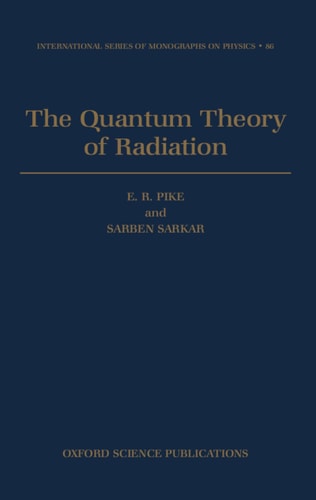
The Quantum Theory of Radiation
0
0
As an Amazon Associate and affiliate partner, Menrva Books earns from qualifying purchases. Learn more
Author Description
This unique book presents a unified, in-depth study of phenomena in photon-matter interactions over a range of many orders of energy. It provides a thorough treatment of relativistic quantum electrodynamics from the quantum field theoretic approach, together with non-relativistic theory in both confined and unconfined geometries. The predictions of QED have been verified to a greater accuracy than any other physical theory. Moreover QED is a paradigm for other gauge theories, and it is presented in such a way that the generalization to other gauge theories is natural. Gauge and Poincare symmetry properties and the non-existence of a photon wave function are thoroughly discussed. Starting from the Dirac equation, the non-relativistic interaction of the electron with the electromagnetic field is derived as an effective Hamiltonian of multipole expansions. Succeeding chapters fully develop relativistic QED and quantum optics. The limitations of QED and the necessity of electroweak theory and quantum chromodynamics are also discussed, and the final chapters are devoted to quantum optics inside cavities, concluding with a study of highly non-classical states of the light field such as photon number, squeezed and two photon entangled states. The book includes worked examples and exercises. In addition to its wide usefulness for theoretical physicists, this volume will help workers in quantum optics to gain a deeper understanding of the foundations of their subject, and field theorists will find concrete examples of open systems, which are beginning to influence their basic approaches.
Menrva's Summary
THE THESIS
This volume investigates the foundational principles and mathematical frameworks of quantum electrodynamics (QED) and its application to photon-matter interactions across varying energy scales. Authors E. R. Pike and Sarben Sarkar utilize their expertise in theoretical physics to synthesize relativistic quantum field theory with non-relativistic approaches. The text establishes QED as a primary gauge theory while providing the necessary derivations to bridge the gap between fundamental electron-field interactions and advanced quantum optics. By examining both confined and unconfined geometries, the authors provide a rigorous structure for understanding the limitations and extensions of current physical models.
THE SCOPE MAP
What You Will Find
- Comprehensive derivations of relativistic quantum electrodynamics from field theoretic principles.
- Analysis of gauge and Poincare symmetry properties alongside the non-existence of a photon wave function.
- Examination of non-classical light states including squeezed and two-photon entangled states.
- Practical pedagogical tools such as worked examples and exercises for advanced students and researchers.
THE AUTHORITY PERSPECTIVE
Experts recognize this monograph as a rigorous resource for theoretical physicists and researchers in quantum optics. Readers frequently note the high academic density of the prose, which serves as a foundational reference for those seeking to understand the transition from QED to electroweak theory and quantum chromodynamics.
Page Count:
360
Publication Date:
1996-02-22
Publisher:
Clarendon Press
ISBN-10:
0198520328
ISBN-13:
9780198520320
Science
Quantum Theory
Academic
Quantum optics
Physics
textbook