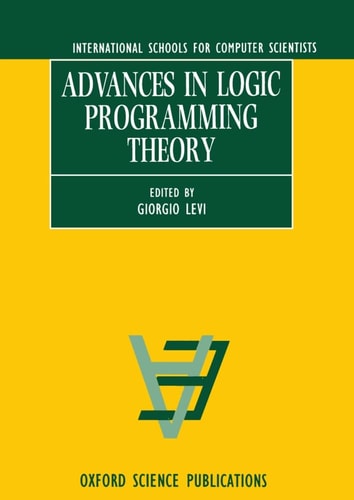
Advances in Logic Programming Theory
0
0
As an Amazon Associate and affiliate partner, Menrva Books earns from qualifying purchases. Learn more
Author Description
Logic programming has emerged over the last five years as one of the most promising new programming paradigms and as a very active research area. The PROLOG experience has shown that relevant problems in areas such as expert systems, deductive databases, knowledge representation, and rapid prototyping can profitably be tackled by logic programming technology. It has also shown that the performance of PROLOG systems can compare with more traditional programming languages by means of sophisticated optimization and implementation of a new class of languages: the concurrent logic languages. Many recent advances in the theory of logic programs are related to extensions of the basic positive logic language and the related semantic problems. The original non-monotonic negation-as-failure rule has been extended in various ways and provided with new declarative characterizations. Other new language constructs are constraints (which lead to a very important extension of the paradigm which allows us to compute on new domains), concurrency, and modules and objects. This book, written by a team of international experts, goes beyond the classical theory to discuss these recent advances for the first time in a systematic form. The work is intended for advanced students of computer science, logic programming and artificial intelligence.
Menrva's Summary
THE THESIS
This book investigates the theoretical evolution of logic programming beyond classical frameworks to address modern computational requirements. Giorgio Levi, alongside a team of international experts, synthesizes recent developments in the field to provide a comprehensive overview of the paradigm. The text examines how logic programming has expanded from its initial applications in expert systems and deductive databases to incorporate complex constructs such as constraints, concurrency, and modularity. By analyzing the semantic problems associated with these extensions, the authors establish a rigorous foundation for understanding the current state of logic programming technology.
THE SCOPE MAP
What You Will Find
- Theoretical extensions of the basic positive logic language including non-monotonic negation-as-failure rules.
- Methodologies for implementing concurrent logic languages and optimizing system performance.
- Analysis of constraint-based programming and its application to new computational domains.
- Examination of modularity and object-oriented constructs within the logic programming paradigm.
THE AUTHORITY PERSPECTIVE
Experts identify this work as a foundational text for advanced students and researchers seeking a systematic treatment of logic programming theory. Readers frequently note the academic density of the prose, which is tailored specifically for those already familiar with the core principles of computer science and artificial intelligence.
Page Count:
272
Publication Date:
1995-02-02
Publisher:
Clarendon Press
ISBN-10:
0198538537
ISBN-13:
9780198538530
Computer Science
Programming
Technology