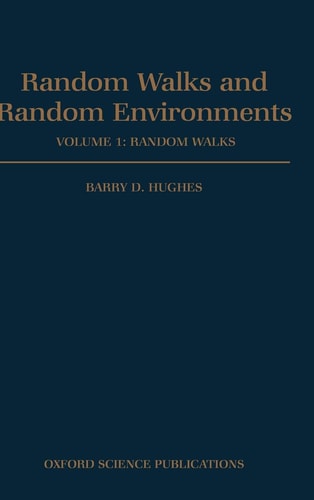
Random Walks and Random Environments: Volume 1: Random Walks
0
0
As an Amazon Associate and affiliate partner, Menrva Books earns from qualifying purchases. Learn more
Author Description
This is the first of two volumes devoted to probability theory in physics, physical chemistry, and engineering, providing an introduction to the problem of the random walk and its applications. In its simplest form, the random walk describes the motion of an idealized drunkard and is a discreet analogy of the diffusion process. A thorough account is given of the theory of random walks on discreet spaces (lattices or networks) and in continuous spaces, including those processed with random waiting time between steps. Applications discussed include dielectric relaxation, charge transport in the xerographic process, turbulent dispersion, diffusion through a medium with traps, laser speckle and the conformations of polymers in dilute solution. Prior knowledge of probability theory would be helpful, but not assumed. An extensive bibliography concludes the book.
Menrva's Summary
THE THESIS
This volume investigates the mathematical theory of random walks and their diverse applications across physical sciences and engineering. Barry D. Hughes provides a comprehensive examination of random walk models, bridging the gap between theoretical probability and practical diffusion processes. The text serves as a foundational resource for researchers and students, utilizing a structured approach to explain motion in both discrete lattices and continuous spaces. By connecting abstract mathematical frameworks to real-world phenomena, the author establishes a rigorous basis for understanding stochastic processes.
THE SCOPE MAP
What You Will Find
- Theoretical analysis of random walks on discrete lattices and networks.
- Mathematical modeling of diffusion processes and random waiting times.
- Applications in dielectric relaxation, charge transport, and turbulent dispersion.
- Extensive bibliographic references for further academic inquiry.
THE AUTHORITY PERSPECTIVE
Experts recognize this work as a foundational text for those applying probability theory to physical systems. Readers frequently note the technical density of the prose, which requires a solid grasp of mathematical principles to fully utilize the provided models.
Page Count:
654
Publication Date:
1995-05-18
Publisher:
Clarendon Press
ISBN-10:
0198537883
ISBN-13:
9780198537885
Statistical physics
Physics
Mathematics
Probability Theory
Engineering
Chemistry Physical
Physical Chemistry
Community Tags
Similar Books