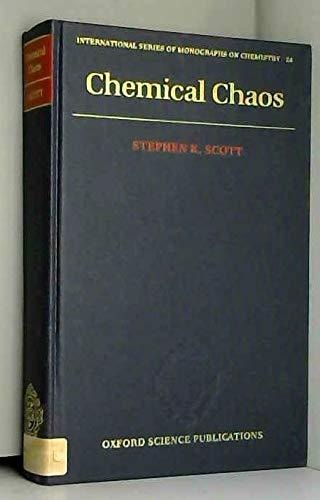
Chemical Chaos
0
0
As an Amazon Associate and affiliate partner, Menrva Books earns from qualifying purchases. Learn more
Author Description
Chaos theory challenges fundamental ideas in all areas of science, and many of the best examples arise in chemistry. This valuable account of chemical chaos reviews both theory and experiment, emphasizing the simple features that combine to produce 'order within disorder'. The basic building blocks for chaos--nonlinearity and feedback--occur quite naturally in chemical systems. Chaos does not appear suddenly or at random, but is created through one of a small number of highly ordered sequences of increasing complexity. These sequences are comprised of qualitative changes in behavior or 'bifurcations.' The author begins by revealing the links between chemical kinetics and the interdisciplinary subject of dynamical systems. Various bifurcation sequences are then introduced through representative model schemes, with the emphasis on generality and simplicity. Various experimental and diagnostic techniques to test for chaos are then described, and the remaining chapters review experimental studies in a wide range of chemical and biochemical systems. The work is important for researchers and advanced undergraduates in physical chemistry, physics, mathematics, biology, and chemical and mechanical engineering.
Menrva's Summary
THE THESIS
This book investigates how chaos theory manifests within chemical systems, challenging traditional scientific assumptions about order and disorder. Author Stephen K. Scott, an expert in physical chemistry, synthesizes theoretical frameworks with empirical data to demonstrate how nonlinearity and feedback loops drive complex chemical behaviors. The text provides a structured argument for viewing chemical kinetics through the lens of dynamical systems, emphasizing the predictable sequences that lead to chaotic states.
THE SCOPE MAP
What You Will Find
- Analysis of bifurcation sequences and their role in chemical complexity
- Methodologies for diagnosing and testing for chaos in laboratory settings
- Review of experimental studies across diverse chemical and biochemical systems
- Integration of chemical kinetics with interdisciplinary dynamical systems theory
THE AUTHORITY PERSPECTIVE
Experts identify this monograph as a foundational text for researchers and advanced students navigating the intersection of chemistry and nonlinear dynamics. Readers frequently note the technical density of the prose, which requires a strong background in physical chemistry and mathematics to fully grasp the presented models.
Page Count:
480
Publication Date:
1991-08-01
Publisher:
Oxford University Press
ISBN-10:
0198556519
ISBN-13:
9780198556510
Science
Biology
Engineering
Physics
Chemistry
Chemistry Physical
Mathematics
Chaotic behavior in systems