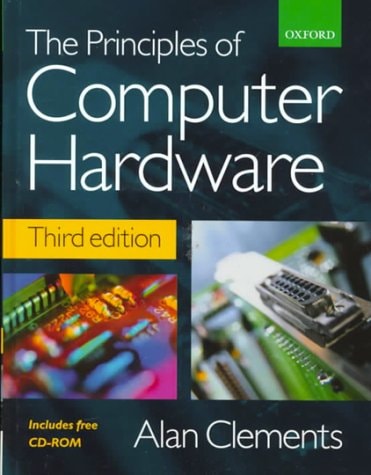
The Principles of Computer Hardware
0
0
As an Amazon Associate and affiliate partner, Menrva Books earns from qualifying purchases. Learn more
Author Description
Principles of Computer Hardware, now in its third edition, provides a first course in computer architecture or computer organization for undergraduates. The book covers the core topics of such a course, including Boolean algebra and logic design; number bases and binary arithmetic; the CPU; assembly language; memory systems; and input/output methods and devices. It then goes on to cover the related topics of computer peripherals such as printers; the hardware aspects of the operating system; and data communications, and hence provides a broader overview of the subject. Its readable, tutorial-based approach makes it an accessible introduction to the subject. The book has extensive in-depth coverage of two microprocessors, one of which (the 68000) is widely used in education. All chapters in the new edition have been updated. Major updates include: powerful software simulations of digital systems to accompany the chapters on digital design; a tutorial-based introduction to assembly language, including many examples; a completely rewritten chapter on RISC, which now covers the ARM computer.
Menrva's Summary
THE THESIS
This text investigates the fundamental principles of computer architecture and organization required for undergraduate-level study. Author Alan Clements utilizes his academic background to provide a structured framework that bridges the gap between basic logic design and complex system integration. The book employs a tutorial-based methodology to explain how hardware components function individually and within the broader context of a computing system.
THE SCOPE MAP
What You Will Find
- Comprehensive coverage of Boolean algebra, logic design, and binary arithmetic.
- Detailed analysis of CPU architecture, memory systems, and input/output device management.
- Practical tutorials on assembly language programming using the 68000 microprocessor.
- Updated technical modules covering RISC architecture and the ARM processor.
THE AUTHORITY PERSPECTIVE
Experts and educators frequently cite this work as a foundational text for students entering the field of computer engineering. Readers often note the clarity of the tutorial-based approach, which effectively balances theoretical concepts with practical hardware implementation.
Page Count:
699
Publication Date:
1991-11-01
Publisher:
Oxford University Press
ISBN-10:
0198537654
ISBN-13:
9780198537656
Architecture
System Design
Peripherals
Computer Science
textbook
Engineering
Hardware & DIY
Hardware
Community Tags
Other Editions(3)


Similar Books