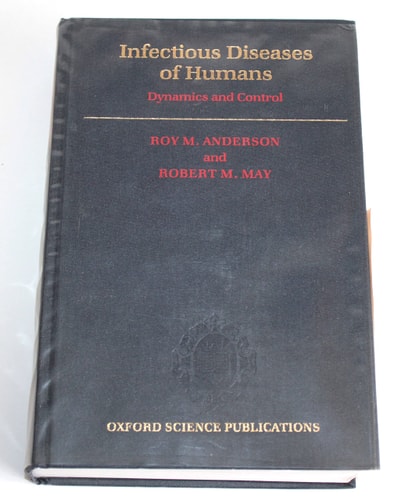
Infectious Diseases of Humans: Dynamics and Control
0
0
As an Amazon Associate and affiliate partner, Menrva Books earns from qualifying purchases. Learn more
Author Description
This book deals with infectious diseases -- viral, bacterial, protozoan and helminth -- in terms of the dynamics of their interaction with host populations. The book combines mathematical models with extensive use of epidemiological and other data. This analytic framework is highly useful for the evaluation of public health strategies aimed at controlling or eradicating particular infections. Such a framework is increasingly important in light of the widespread concern for primary health care programs aimed at such diseases as measles, malaria, river blindness, sleeping sickness, and schistosomiasis, and the advent of AIDS/HIV and other emerging viruses. Throughout the book, the mathematics is used as a tool for thinking clearly about fundamental and applied problems having to do with infectious diseases. The book is divided into two parts, one dealing with microparasites (viruses, bacteria and protozoans) and the other with macroparasites (helminths and parasitic arthropods). Each part begins with simple models, developed in a biologically intuitive way, and then goes on to develop more complicated and realistic models as tools for public health planning. The book synthesizes previous work in this rapidly growing field (much of which is scattered between the ecological and the medical literature) with a good deal of new material.
Menrva's Summary
THE THESIS
This book investigates the complex dynamics of infectious disease transmission and the mathematical frameworks required to evaluate public health control strategies. Authors Robert M. May and Roy M. Anderson leverage their extensive backgrounds in theoretical biology and ecology to bridge the gap between mathematical modeling and clinical epidemiology. By synthesizing existing research with new analytical methods, they provide a structured approach to understanding how viral, bacterial, and parasitic infections interact with host populations. The text serves as a rigorous guide for applying quantitative tools to solve fundamental problems in disease eradication and management.
THE SCOPE MAP
What You Will Find
- Mathematical models for microparasites including viruses, bacteria, and protozoans.
- Analytical frameworks for macroparasites such as helminths and parasitic arthropods.
- Comparative analysis of disease dynamics for conditions like malaria, measles, and HIV/AIDS.
- Methodologies for evaluating the efficacy of public health intervention and control programs.
THE AUTHORITY PERSPECTIVE
Experts recognize this work as a foundational text that successfully integrates ecological theory with medical practice. Readers frequently note the high level of mathematical density, which makes the book a primary resource for researchers and public health professionals focused on disease modeling.
Page Count:
768
Publication Date:
1991-07-11
Publisher:
Oxford University Press
ISBN-10:
0198545991
ISBN-13:
9780198545996
Science
Biology
Public Health
Mathematics
Medicine
Communicable Diseases
Epidemiology
Community Tags
Similar Books