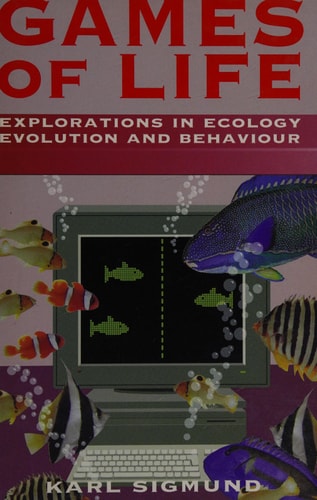
Games of Life: Explorations in Ecology, Evolution, and Behaviour
0
0
As an Amazon Associate and affiliate partner, Menrva Books earns from qualifying purchases. Learn more
Author Description
Life is often a matter of gambles, pay-offs, and trade-offs, just like a game. This book takes readers on a tour through the games and computer simulations that are actually helping to advance knowledge in such fields as ecology, evolution, and animal behavior. Although the book deals with questions of vital importance, like sex and survival, it does so in the lively, entertaining spirit of game-playing. It starts with artificial life and self-replicating automata, a topic ideally suited for a computer-games approach. The book goes on to study pursuit games between predators and prey, and chaotic motion and its role in ecology. Games of chance and statistical paradoxes illuminate the randomness in molecular evolution, while some bizarre double games played by chromosomes help explain the laws of population genetics. Other topics include courtship, ownership, partnership, and brinksmanship--illustrated through the game of poker and computer tournaments. No other book explains so well why scientific observations and insights can be structured as the rules of a survival game, and what happens when they are assembled on a computer or in the mind and allowed to run their course. General readers as well as professionals and students in ecological, evolutionary, and behavioral studies will find this a fascinating and informative work.
Menrva's Summary
THE THESIS
This book investigates how the principles of game theory and computer simulation provide a rigorous framework for understanding the complex dynamics of ecology, evolution, and animal behavior. Karl Sigmund, a mathematician known for his work in evolutionary game theory, synthesizes complex biological phenomena into accessible models. He argues that the strategic interactions found in games—such as pay-offs, trade-offs, and risk management—are fundamental to the survival strategies observed in the natural world. By utilizing computer simulations and mathematical modeling, the author demonstrates how abstract rules can replicate and explain biological processes ranging from molecular evolution to social courtship rituals.
THE SCOPE MAP
What You Will Find
- Analysis of self-replicating automata and artificial life simulations.
- Mathematical modeling of predator-prey dynamics and chaotic motion in ecological systems.
- Application of game theory concepts like poker and brinksmanship to animal behavior and partnership.
- Exploration of statistical paradoxes and their influence on molecular evolution and population genetics.
THE AUTHORITY PERSPECTIVE
Experts and academics recognize this work as a highly accessible entry point into the application of game theory within the biological sciences. Readers frequently note that while the prose remains engaging and lively, it maintains a high level of scientific integrity suitable for both students and professionals in the field.
Page Count:
256
Publication Date:
1993-08-26
Publisher:
Oxford University Press
ISBN-10:
0198547838
ISBN-13:
9780198547839
Science
Life Biology
Game theory
Mathematics
Biology
Ecology
Evolutionary Biology
Community Tags
Similar Books