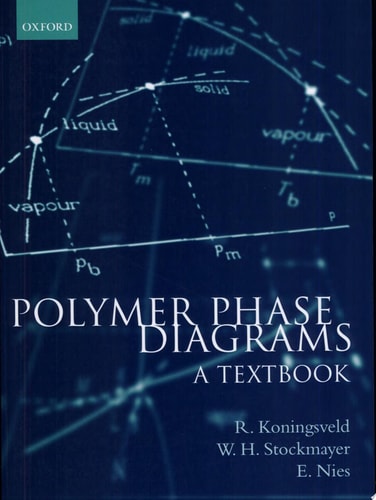
Polymer Phase Diagrams: A Textbook
0
0
As an Amazon Associate and affiliate partner, Menrva Books earns from qualifying purchases. Learn more
Author Description
Polymeric materials include plastics, gels, synthetic fibres, and rubbers. They are all-important both in industry and in daily life. Unlike liquid water, ice, or sugar solution, polymers are not homogeneous. They are said to consist of two or more phases, and their production and processing, as well as their properties and uses, depend on an understanding of the transitions that take place between these phases. Over the last two decades, phase diagrams of considerably complexity have begun to appear in the polymer literature. Phase transitions occur abundantly in polymer production and processing, are often encountered in polymer research, or are instrumental in laboratory methods of polymer characterization. This new textbook uses fundamental principles to classify phase separation phenomena in polymer systems, and describes simple molecular models explaining the observed behavior. It supplies insight in the reading and construction of complex phase diagrams, as well as an understanding of the relationships that must exist between different phase transitions. Containing hundreds of diagrams, exercises at chapter ends, and several useful appendices, this text should be useful for anyone teaching or studying a course in polymer science.
Menrva's Summary
THE THESIS
This textbook investigates the fundamental principles governing phase separation phenomena in complex polymer systems. The authors, E. Nies, R. Koningsveld, and W. H. Stockmayer, leverage their expertise in polymer physics to provide a rigorous framework for interpreting and constructing phase diagrams. By applying molecular models to the observed behavior of plastics, gels, and synthetic fibers, the text establishes the necessary relationships between various phase transitions encountered in industrial and laboratory settings.
THE SCOPE MAP
What You Will Find
- Detailed classification of phase separation phenomena in diverse polymer systems
- Molecular models explaining observed phase transition behaviors
- Hundreds of illustrative diagrams for visual analysis
- End-of-chapter exercises and technical appendices for pedagogical support
THE AUTHORITY PERSPECTIVE
Experts and educators recognize this text as a comprehensive resource for students and researchers navigating the complexities of polymer thermodynamics. Readers frequently note the technical density of the prose, which requires a solid foundation in physical chemistry to fully grasp the presented models.
Page Count:
360
Publication Date:
2001-05-03
Publisher:
Oxford University Press
ISBN-10:
0198556349
ISBN-13:
9780198556343
Science
Plastics
Chemistry
Polymers
textbook
Phase Diagrams
Community Tags
Similar Books