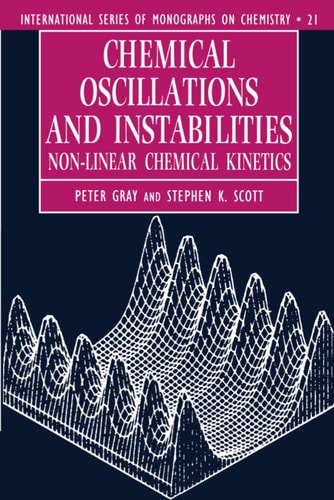
Chemical Oscillations and Instabilities: Non-linear Chemical Kinetics
0
0
As an Amazon Associate and affiliate partner, Menrva Books earns from qualifying purchases. Learn more
Author Description
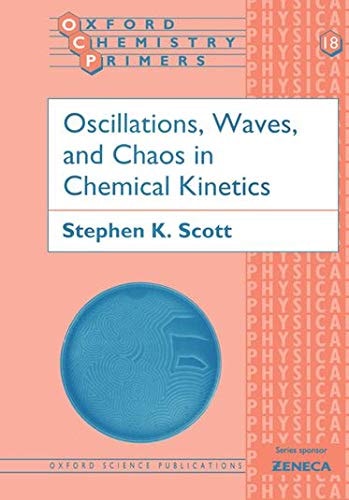
Today, scientists in many fields are expressing considerable interest in non-linearity and the ideas of oscillations and chaos. Chemical reactions provide perfect examples of these phenomena. This book is an excellent introduction to the area of nonlinear phenomena in chemical kinetics that involve chemical feedback such as chain branching, autocatalysis, and self-heating. The emphasis is on physical and pictorial representation, and on identifying those gross features which are essential. The experimental conditions under which such behavior will occur can be predicted using simple mathematical recipes, and these are also included. Readers will find full discussions of long-lived oscillations for autocatalytic or exothermic reactions in closed vessels and stationary states, bistability, and oscillations in continuous flow reactors and diffusion cells. Other topics considered include chemical wave propagation, pattern selection and formation, heterogeneous reactions, complex oscillations, quasiperiodicity, and chemical chaos, both forced and spontaneous. The second part of the book describes actual experimental systems, such as the Belousov-Zhabotinskii reaction, and include discussion of the behavior of important gas-phase reactions. This volume is an ideal sourcebook of applied problems for graduate courses in dynamical systems, advanced chemical kinetics, and chemical reactor engineering, as well as for research workers in physical chemistry, and mathematicians, biologists, physicists, and physiologists.
Menrva's Summary
THE THESIS
This text investigates the fundamental principles of non-linear chemical kinetics, specifically focusing on how feedback mechanisms like autocatalysis and self-heating generate complex oscillatory and chaotic behaviors. Authors Peter Gray and Stephen K. Scott utilize their expertise in physical chemistry to bridge the gap between theoretical mathematical models and observable experimental phenomena. The work provides a structured framework for predicting chemical instabilities, emphasizing physical intuition and pictorial representation over purely abstract derivation.
THE SCOPE MAP
What You Will Find
- Mathematical recipes for predicting experimental conditions of chemical oscillations.
- Analysis of autocatalytic and exothermic reactions in closed vessels and continuous flow reactors.
- Examination of complex phenomena including chemical wave propagation, pattern formation, and spontaneous chaos.
- Detailed case studies of experimental systems such as the Belousov-Zhabotinskii reaction and gas-phase reactions.
THE AUTHORITY PERSPECTIVE
Experts recognize this volume as a foundational reference for researchers and graduate students in chemical kinetics and dynamical systems. Readers frequently note the balance between rigorous mathematical modeling and the practical application of these theories to real-world chemical reactors.
Page Count:
472
Publication Date:
1994-06-16
Publisher:
Clarendon Press
ISBN-10:
0198558643
ISBN-13:
9780198558644
Science
Oscillations
Nonlinear Dynamics
Physical Chemistry
Nonlinear theories
Mathematics
Chemical Kinetics
Chemicals
Chemistry
Community Tags
Similar Books