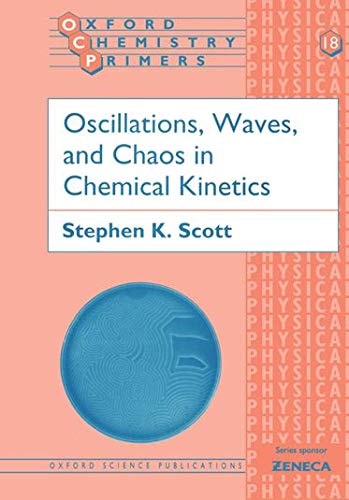
Oscillations, Waves, and Chaos in Chemical Kinetics
0
0
As an Amazon Associate and affiliate partner, Menrva Books earns from qualifying purchases. Learn more
Author Description
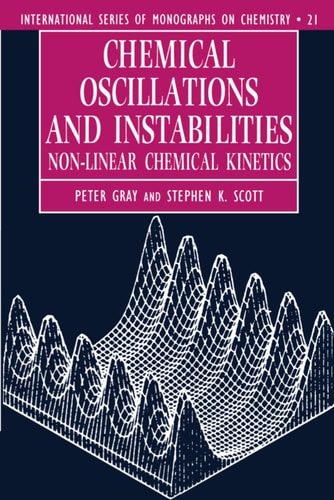
The phenomena of oscillations, travelling waves, and chaos in reacting chemical systems began as curiosities but now support an active, international research field. This book shows how these "exotic" patterns arise from the underlying chemical mechanisms. The origin of "chemical feedback" is revealed using three example reactions: the isolate-reductant (Landolt) reaction, the Belousov-Zhabotinsky reaction, and the combustion of hydrogen. Thermal feedback is also discussed. These mechanisms lead to clock reactions and travelling reaction fronts, thermal runaway, and flames; to oscillations and excitability; to target patterns, spiral and scroll waves; to bistability, ignition, extinction, and hysteresis; and to complex oscillations and chaos in flow reactors. These phenomena are related to important processes in biology, including the development of cardiac arrhythmias, nerve signal transmission, and animal coat patterning.
Menrva's Summary
THE THESIS
This book investigates the fundamental chemical mechanisms that produce complex, non-linear phenomena such as oscillations, travelling waves, and chaos in reacting systems. Stephen K. Scott, a recognized authority in chemical kinetics, utilizes a structured approach to explain how chemical and thermal feedback loops drive these exotic patterns. By examining specific reactions, the author provides a framework for understanding how simple molecular interactions scale into macroscopic behaviors like combustion and biological signaling.
THE SCOPE MAP
What You Will Find
- Analysis of the Landolt reaction, Belousov-Zhabotinsky reaction, and hydrogen combustion.
- Examination of thermal feedback mechanisms including ignition, extinction, and hysteresis.
- Discussion of spatial patterns such as target patterns, spiral waves, and scroll waves.
- Applications of chemical kinetics to biological systems like cardiac arrhythmias and nerve signal transmission.
THE AUTHORITY PERSPECTIVE
Experts and students frequently cite this text as a concise, foundational primer for understanding non-linear chemical dynamics. The prose is noted for its technical clarity, making complex kinetic concepts accessible to those with a background in physical chemistry.
Page Count:
96
Publication Date:
1994-09-29
Publisher:
Oxford University Press
ISBN-10:
0198558449
ISBN-13:
9780198558446
Science
Non-Fiction
Chaotic behavior in systems
Chemistry
Physics
Chemical Kinetics