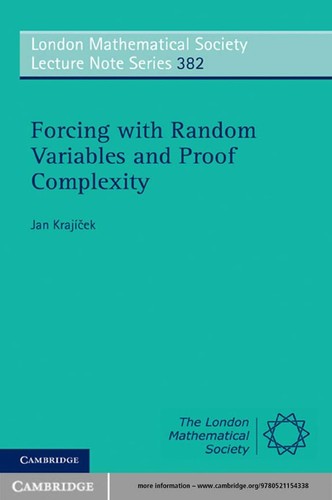
Forcing with Random Variables and Proof Complexity
0
0
As an Amazon Associate and affiliate partner, Menrva Books earns from qualifying purchases. Learn more
Author Description
This book introduces a new approach to building models of bounded arithmetic, with techniques drawn from recent results in computational complexity. Propositional proof systems and bounded arithmetics are closely related. In particular, proving lower bounds on the lengths of proofs in propositional proof systems is equivalent to constructing certain extensions of models of bounded arithmetic. This offers a clean and coherent framework for thinking about lower bounds for proof lengths, and it has proved quite successful in the past. This book outlines a brand new method for constructing models of bounded arithmetic, thus for proving independence results and establishing lower bounds for proof lengths. The models are built from random variables defined on a sample space which is a non-standard finite set and sampled by functions of some restricted computational complexity. It will appeal to anyone interested in logical approaches to fundamental problems in complexity theory
Menrva's Summary
THE THESIS
This book introduces a novel method for constructing models of bounded arithmetic, leveraging techniques from computational complexity to address fundamental problems in proof theory and complexity theory. The author, Jan Krajíček, presents a new approach to building models of bounded arithmetic, drawing on recent results in computational complexity. The work highlights the close relationship between propositional proof systems and bounded arithmetics, where proving lower bounds on proof lengths is equivalent to extending models of bounded arithmetic. This book outlines a new method for constructing these models using random variables defined on a non-standard finite set, sampled by functions of restricted computational complexity, offering a framework for establishing lower bounds and independence results.
THE SCOPE MAP
- Introduction to the relationship between propositional proof systems and bounded arithmetics.
- Explanation of how proving lower bounds for proof lengths relates to extending models of bounded arithmetic.
- Detailed outline of a new method for constructing models of bounded arithmetic.
- Use of random variables defined on non-standard finite sets.
- Sampling of models by functions of restricted computational complexity.
- Application of these techniques to proving independence results.
- Application of these techniques to establishing lower bounds for proof lengths.
- Relevance to logical approaches in complexity theory.
THE AUTHORITY PERSPECTIVE
The book is presented as a significant contribution to the field, offering a novel framework for understanding lower bounds in proof complexity. Its approach, rooted in computational complexity and model theory, is intended to appeal to researchers and students interested in the logical foundations of computer science. The method of constructing models from random variables is highlighted as a key innovation. The work is positioned as a resource for those investigating the deep connections between proof lengths and the structure of computational complexity.
Page Count:
247
Publication Date:
2011-01-01
ISBN-10:
0521154332
ISBN-13:
9780521154338
Non-Fiction
Science
Logic
Computer Science
Mathematics
Computational complexity
Community Tags
Similar Books