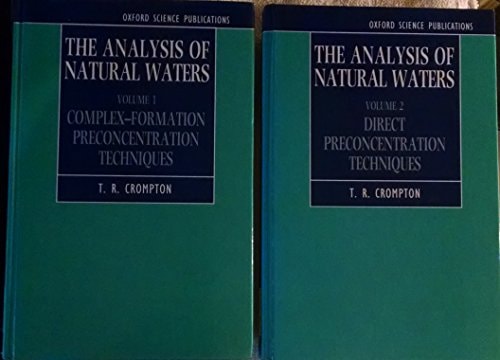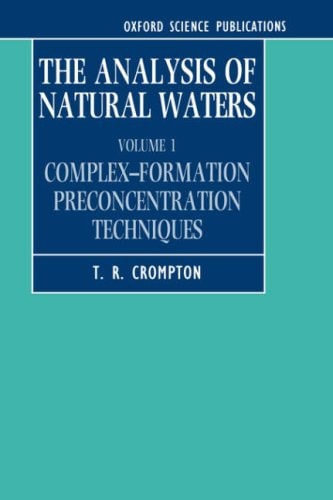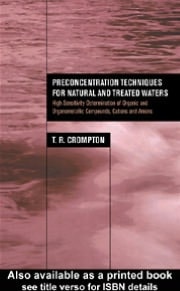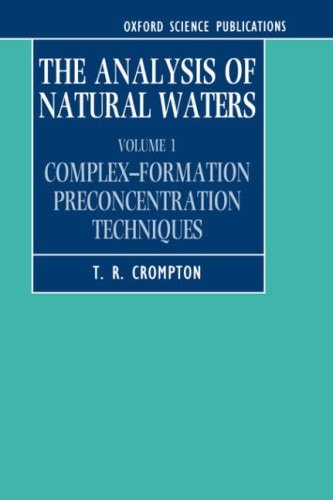
The Analysis of Natural Waters: Volume 1: Complex-Formation Preconcentration Techniques
0
0
As an Amazon Associate and affiliate partner, Menrva Books earns from qualifying purchases. Learn more
Author Description
One of the problems in the analysis of natural and potable waters is that the equipment used is often insufficiently sensitive to detect the low concentrations of organic and inorganic substances present in the samples. The problem can, however, be overcome to some extent by preconcentrating the sample before analysis. This two-volume set provides a comprehensive review of the techniques available for preconcentration and explains how each can be applied to cations, anions, organic substances, and organometallic compounds. Volume 1 describes methods involving complex formation, while Volume 2 covers direct preconcentration techniques. Both books contain useful practical advice which will be of value to all analytical chemists and environmental scientists concerned with water analysis.
Menrva's Summary
THE THESIS
This volume investigates the methodological challenge of detecting trace-level organic and inorganic substances in natural and potable water samples through the application of complex-formation preconcentration. T. R. Crompton, an established authority in analytical chemistry, synthesizes existing laboratory techniques to address the limitations of standard detection equipment. The text provides a systematic framework for isolating and concentrating analytes, ensuring that environmental scientists can achieve the sensitivity required for accurate water quality assessment.
THE SCOPE MAP
What You Will Find
- Detailed methodologies for complex-formation preconcentration techniques.
- Application protocols for cations, anions, organic substances, and organometallic compounds.
- Practical laboratory advice for enhancing the sensitivity of analytical instrumentation.
- Comparative analysis of preconcentration strategies for diverse water matrices.
THE AUTHORITY PERSPECTIVE
Analytical chemists and environmental researchers frequently cite this work as a foundational technical resource for laboratory water analysis. Experts highlight the text for its practical focus on overcoming detection limits in environmental monitoring.
Page Count:
232
Publication Date:
1993-03-18
Publisher:
Oxford University Press
ISBN-10:
0198553951
ISBN-13:
9780198553953
Science
Analytical Chemistry
Water Chemistry
Chemistry
Water analysis
Water Quality
Community Tags
Similar Books