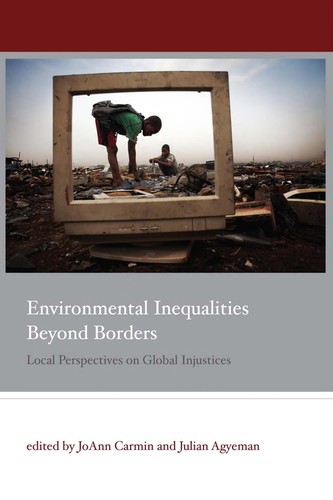
Environmental Inequalities Beyond Borders
0
0
As an Amazon Associate and affiliate partner, Menrva Books earns from qualifying purchases. Learn more
Author Description
Multinational corporations often exploit natural resources or locate factories in poor countries far from the demand for the products and profits that result. Developed countries also routinely dump hazardous materials and produce greenhouse gas emissions that have a disproportionate impact on developing countries. This book investigates how these and other globalized practices exact high social and environmental costs as poor, local communities are forced to cope with depleted resources, pollution, health problems, and social and cultural disruption. Case studies drawn from Africa, Asia, the Pacific Rim, and Latin America critically assess how diverse types of global inequalities play out on local terrains. These range from an assessment of the pros and cons of foreign investment in Fiji to an account of the work of transnational activists combating toxic waste disposal in Mozambique. Taken together, the chapters demonstrate the spatial disconnect between global consumption and production on the one hand and local environmental quality and human rights on the other. The result is a rich perspective not only on the ways industries, governments, and consumption patterns may further entrench existing inequalities but also on how emerging networks and movements can foster institutional change and promote social equality and environmental justice.
Menrva's Summary
THE THESIS
This book investigates the global environmental inequalities that arise from the practices of multinational corporations and developed nations, which disproportionately burden poor, local communities. It examines how depleted resources, pollution, health problems, and social disruption are the consequences of a spatial disconnect between global consumption and production. The book draws on case studies from Africa, Asia, the Pacific Rim, and Latin America to critically assess how these inequalities manifest on local terrains, exploring both the entrenchment of existing disparities and the potential for emerging networks to foster change and promote environmental justice.
THE SCOPE MAP
- Analysis of how multinational corporations exploit resources and locate factories in developing countries.
- Examination of the impact of hazardous material dumping and greenhouse gas emissions from developed countries on developing nations.
- Case studies from Africa, Asia, the Pacific Rim, and Latin America illustrating local environmental costs.
- Assessment of foreign investment in Fiji, including its pros and cons.
- Account of transnational activists combating toxic waste disposal in Mozambique.
- Demonstration of the spatial disconnect between global consumption/production and local environmental quality/human rights.
- Exploration of how industries, governments, and consumption patterns can entrench existing inequalities.
- Discussion of emerging networks and movements that can promote institutional change and social equality.
THE AUTHORITY PERSPECTIVE
The book is regarded as a critical examination of the uneven impacts of globalization on environmental quality and human rights. It is noted for its use of diverse case studies that illustrate the complex interplay between global economic practices and local community experiences. The work is seen as demonstrating how existing inequalities can be reinforced by industrial and consumption patterns, while also highlighting the potential for activism and emerging networks to drive institutional change towards greater social equality and environmental justice.
Page Count:
256
Publication Date:
2011-01-01
ISBN-10:
026201551X
ISBN-13:
9780262015516
Economics
Non-Fiction
Politics
Case studies
Globalization
Community Tags
Similar Books